Cancel In-Progress Tekton Pipelines: Stop Wasting CI on Outdated Commits

Push a commit to a merge request and your review pipeline starts. Spot a typo, push again thirty seconds later - and now two pipelines are running, one of them validating a commit that no longer matters. GitHub Actions solved this years ago with concurrency.cancel-in-progress; Tekton has no built-in equivalent, so on a Tekton-based platform those superseded runs keep burning CPU until they finish, producing results nobody will read.
KubeRocketCI 3.14 closes that gap with a single chart flag: pipelines.cancelInProgress. When enabled, the KRCI Tekton interceptor cancels still-running review PipelineRuns for the same pull request before triggering the replacement. The cancellation is graceful (CancelledRunFinally): the superseded run still executes its finally tasks, so your git provider gets a status for the old commit instead of an eternally "pending" check. This post shows the whole flow live on the local try-kuberocketci testbed - every screenshot and command output is from a real run.
The Problem: Superseded Review Runs Pile Up
A review (pull request) pipeline exists to answer one question: is this commit mergeable? The moment a newer commit lands on the same merge request, that question changes - and every pipeline still validating the old commit is wasted work. The pattern is worst exactly where CI matters most: active MRs with quick fix-up pushes, /recheck comments, rebases. Each event spawns a full pipeline - clone, build, lint, SonarQube scan, image verification - and on a shared cluster those zombie runs compete with useful work for CPU, memory, and runner capacity.
GitHub Actions users express the fix in two lines of YAML:
concurrency:
  group: review-${{ github.ref }}
  cancel-in-progress: true
Tekton, by design, has no such primitive - a PipelineRun is a standalone Kubernetes resource with no concept of "group" or "supersedes". The Tekton community has discussed pipeline concurrency for years without a shipped core feature. So the platform layer has to provide it - and in KubeRocketCI, the natural place is the krci interceptor, the component that already sits between every git webhook and every triggered pipeline.
How Cancel-In-Progress Works
The interceptor enriches webhook payloads for all four supported git providers (GitHub, GitLab, Bitbucket, Gerrit) before Tekton's EventListener instantiates a PipelineRun. That position makes it the perfect referee: it sees the new event before the new run exists, and it can find every old run for the same change because review PipelineRuns are now stamped with a app.edp.epam.com/git-change-number label at creation time.
The design choices matter as much as the mechanism:
- Graceful, not brutal. The interceptor patches
spec.status: CancelledRunFinally- Tekton stops scheduling new tasks and cancels running ones, but the pipeline'sfinallysection still executes. In KubeRocketCI's pipelines-library, that is where commit status is reported back to the git provider - so the superseded commit ends up marked failed, never stuck pending. - Review pipelines only. The
cancelInProgressparameter is injected into review Triggers exclusively. Build pipelines - the ones producing versioned artifacts after a merge - are never cancelled. - Best-effort by contract. If listing or patching fails, the error is logged and the new pipeline triggers anyway. Cancellation can never break your CI.
- Scoped to one change. The label selector matches codebase + pipeline type + change number, so parallel MRs on the same repository never interfere with each other.
- RBAC follows the flag. The interceptor's Role gains
patchonpipelinerunsonly when the feature is enabled.
Enabling it is one Helm value on the pipelines-library chart:
pipelines:
  # Cancel in-progress review PipelineRuns when a new commit is pushed to the same
  # Pull Request / Merge Request / Gerrit change. Cancellation is graceful
  # (spec.status: CancelledRunFinally), so finally tasks of the superseded run still execute.
  cancelInProgress: true
Walkthrough: Two Commits, One Surviving Pipeline
The environment is the same local testbed as my previous posts: a kind cluster with KubeRocketCI, Tekton, and self-hosted GitLab, with the Go sample application test-go-app onboarded and pipelines.cancelInProgress: true set.
Step 1: Open a Merge Request
I create a branch, add a commit, and open a merge request through the GitLab API - the same thing a developer does from the terminal:
$ git checkout -b feature-cancel-demo && git commit -m "feat: add feature (attempt 1)" && git push
# MR !2 "Add feature" opened against main
The webhook fires, and the review pipeline starts. Note the change-number label - this is the handle the interceptor will use later:
$ kubectl -n krci get pipelinerun --show-labels | grep review
review-test-go-app-main-2p446   Unknown   Running   2s
  app.edp.epam.com/codebase=test-go-app,
  app.edp.epam.com/pipelinetype=review,
  app.edp.epam.com/git-change-number=2, ...
Step 2: Push a Fix While the Pipeline Is Still Running
Ninety seconds in - the pipeline is mid-flight, fetch, build and sonar already done, image verification in progress - I notice the typo and push the fix to the same branch:
$ git commit -m "feat: add feature (attempt 2, fixes review)" && git push
GitLab sends the update webhook. The interceptor finds the still-running pipeline for change 2, cancels it, and lets the new one trigger. Twenty seconds later the picture is exactly what you want:
$ kubectl -n krci get pipelinerun
NAME                            SUCCEEDED   REASON      STARTTIME   COMPLETIONTIME
review-test-go-app-main-2p446   False       Cancelled   104s        15s
review-test-go-app-main-8th5r   Unknown     Running     22s
One log line in the interceptor tells the story:
Canceled in-progress PipelineRun review-test-go-app-main-2p446 superseded
by a new event for codebase test-go-app change 2
The Portal shows both runs side by side - the superseded run Cancelled at 1m 29s instead of running to completion, the replacement already underway:
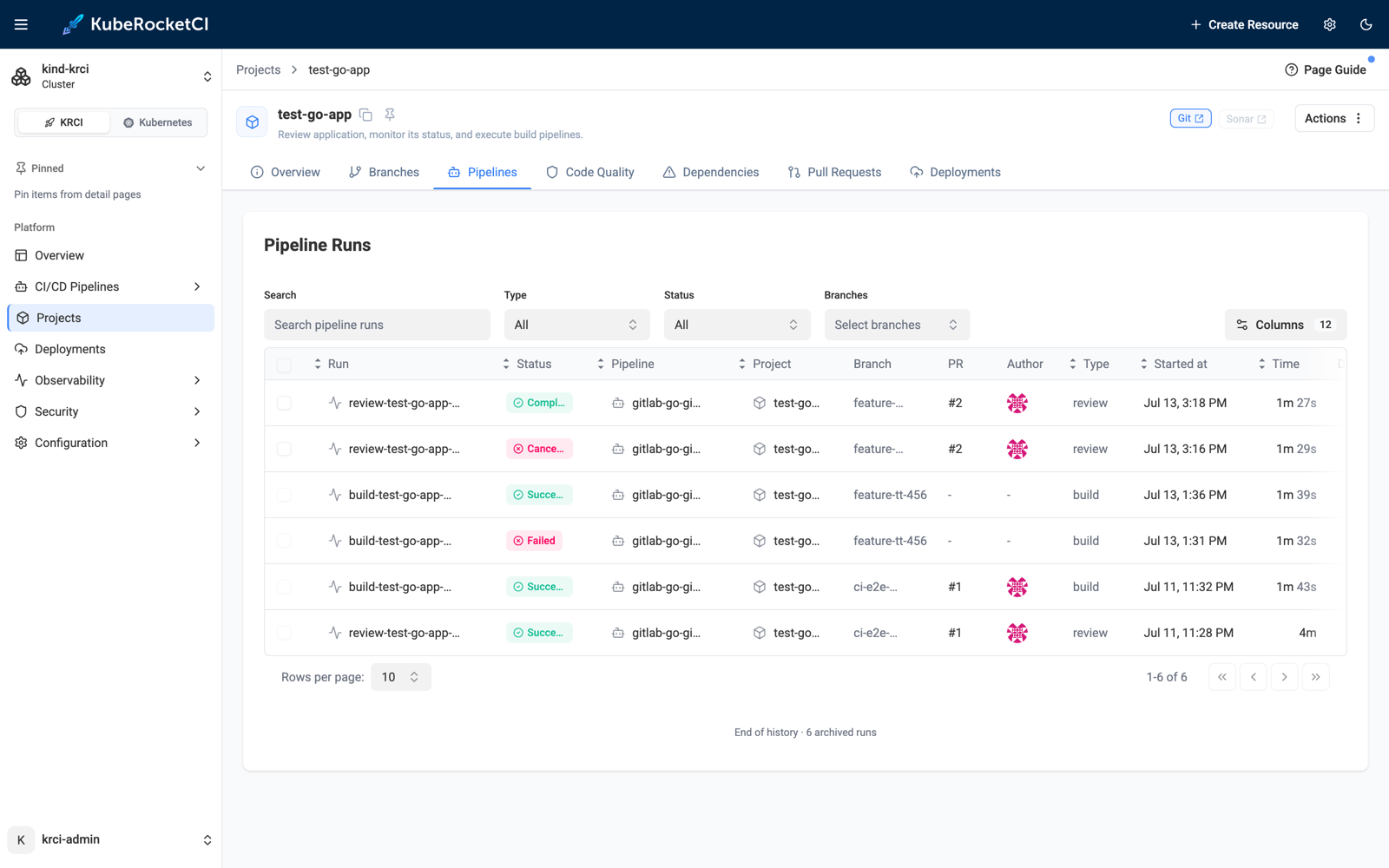
Step 3: Verify the Cancellation Was Graceful
Open the cancelled run in the Portal. The status is Cancelled, the spec says CancelledRunFinally, and the task list is the interesting part:
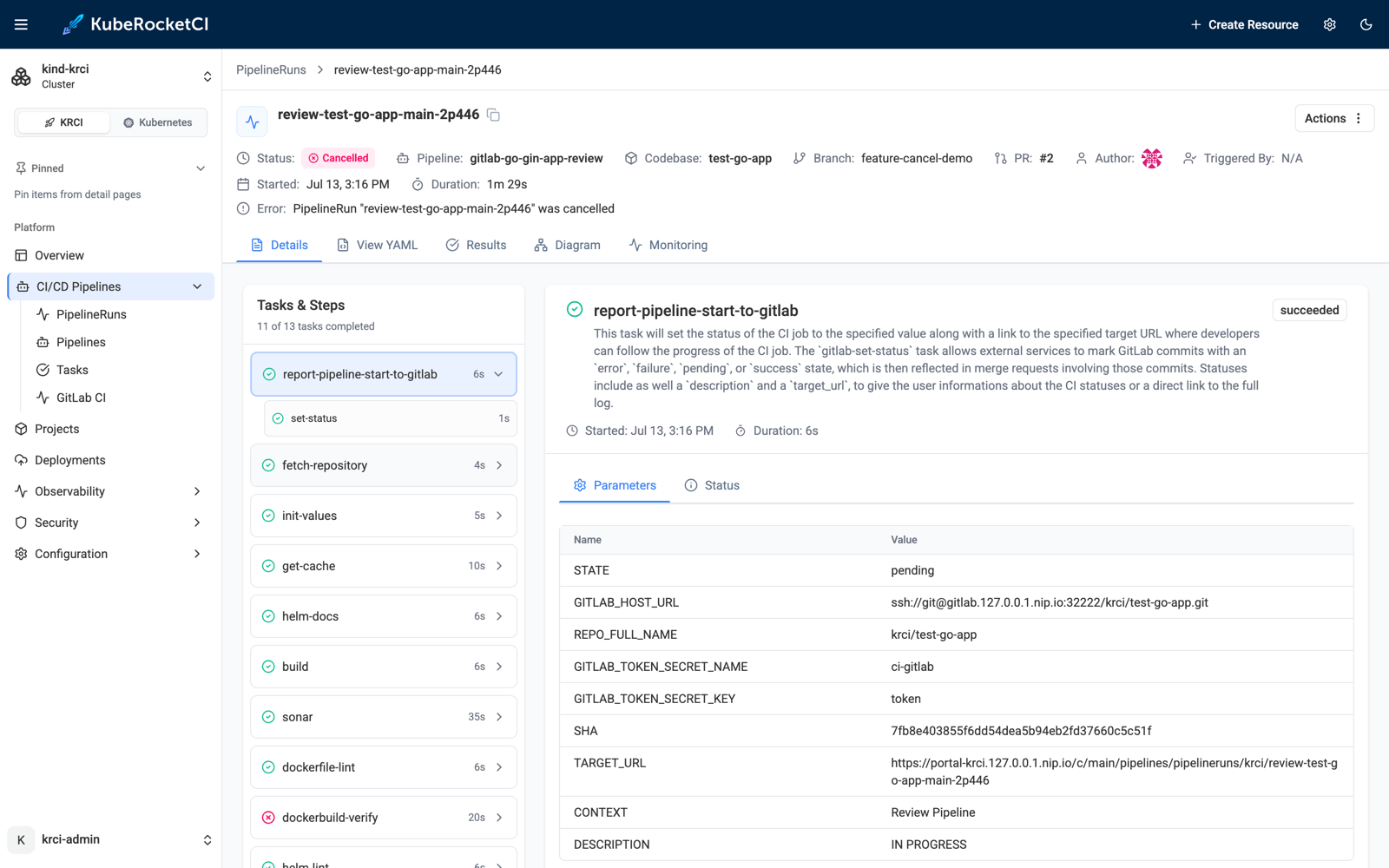
$ kubectl -n krci get taskrun -l tekton.dev/pipelineRun=review-test-go-app-main-2p446
NAME                                       OK      REASON
...-fetch-repository                       True    Succeeded
...-build                                  True    Succeeded
...-sonar                                  True    Succeeded
...-dockerbuild-verify                     False   TaskRunCancelled   <- was in flight
...-gitlab-set-failure-status              True    Succeeded          <- finally task ran
dockerbuild-verify - the task that was running when the second commit arrived - was cancelled. But the finally task gitlab-set-failure-status executed after the cancellation and reported the outcome to GitLab:
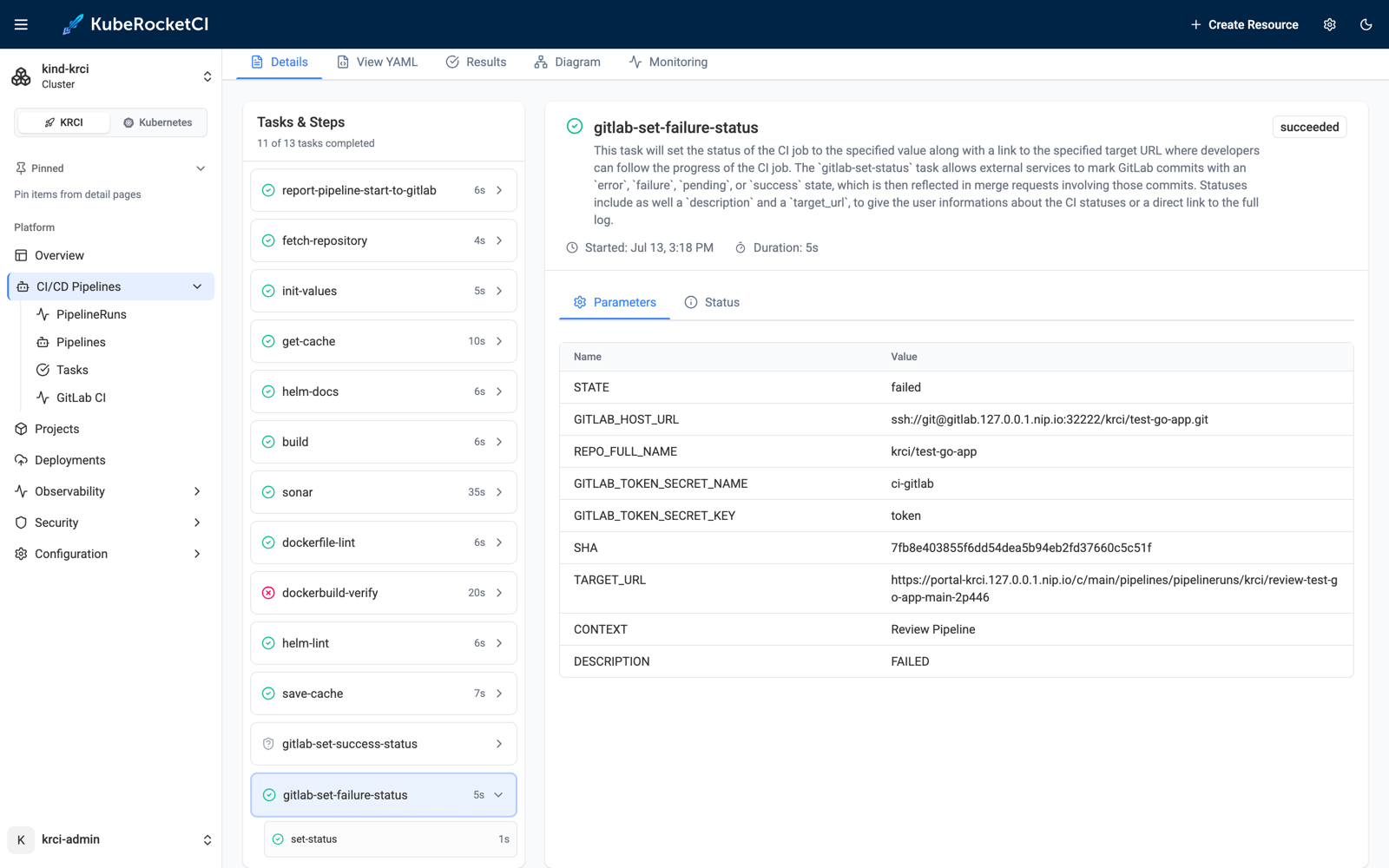
The git provider's view confirms it - no dangling "pending" check anywhere:
# commit #1 (superseded)
$ glab api projects/krci%2Ftest-go-app/repository/commits/7fb8e40/statuses
Review Pipeline -> failed

# commit #2 (current)
$ glab api projects/krci%2Ftest-go-app/repository/commits/5ffb585/statuses
Review Pipeline -> success
The replacement run finished green, the MR shows a passing pipeline for the latest commit, and the cluster spent zero extra minutes on the outdated one.
What This Saves
Back-of-the-envelope for a real team: the review pipeline above takes about 4 minutes of pod time (clone, build, lint, SonarQube, image verification). A ten-developer team pushing an average of one fix-up commit per MR wastes one full pipeline per MR - dozens of pipeline-hours per month on a busy repository, all competing with useful runs for cluster capacity. Concurrency limits and cluster autoscaling treat the symptom; cancelling superseded runs removes the work itself. It is the same reasoning that makes ephemeral environments cheaper than permanent staging: the cheapest workload is the one that stops existing when it stops being useful.
Configuration Reference
| Setting | Where | Default | Effect |
|---|---|---|---|
pipelines.cancelInProgress | pipelines-library Helm values | false | Cancel in-progress review PipelineRuns superseded by a new event for the same change |
app.edp.epam.com/git-change-number | Label stamped on review PipelineRuns | - | Selector the interceptor uses to find superseded runs |
Behavior summary:
- Triggers cancellation: a new commit pushed to the same PR/MR/Gerrit change, and re-trigger comments (
/recheck,/ok-to-test). - Cancels: review PipelineRuns for the same codebase and change number that are not already done or cancelled.
- Never touches: build pipelines, runs for other changes, runs for other codebases.
- On failure: logs the error and proceeds - the new pipeline always triggers.
Handy one-liner to see every run for a given pull request, newest first:
kubectl -n krci get pipelinerun \
  -l app.edp.epam.com/git-change-number=2,app.edp.epam.com/codebase=test-go-app \
  --sort-by=.metadata.creationTimestamp
Frequently Asked Questions
Does Tekton have a built-in equivalent of GitHub Actions cancel-in-progress?
No. Tekton PipelineRuns are independent Kubernetes resources with no native concurrency groups; pipeline concurrency has been a long-running community discussion without a shipped core feature. KubeRocketCI implements the pattern at the platform layer, in the interceptor that already processes every git webhook.
Why CancelledRunFinally instead of just deleting the PipelineRun?
Deleting (or hard-cancelling) a run would leave the superseded commit with a forever-pending status in GitLab or GitHub, and would skip cleanup logic. CancelledRunFinally stops the useless work but still executes the pipeline's finally tasks - in KubeRocketCI's pipeline library that is where the commit status is reported, so the old commit is cleanly marked as failed.
Are build pipelines ever cancelled?
No. The cancelInProgress interceptor parameter is injected into review Triggers only. Build pipelines - triggered by merges and producing versioned artifacts - always run to completion.
Which git providers are supported?
All four KubeRocketCI providers: GitHub, GitLab, Bitbucket, and Gerrit. The change number is parsed from each provider's webhook payload (including Gerrit's, which sends it as either an integer or a string), and the same label-based cancellation logic applies everywhere.
What happens if the cancellation itself fails?
Nothing visible to the developer. Cancellation is best-effort: a failure to list or patch PipelineRuns is logged by the interceptor and the new pipeline is triggered regardless. The worst case is the old behavior - two runs in parallel - never a blocked pipeline.
Can two different merge requests cancel each other's pipelines?
No. The interceptor matches on codebase and pipeline type and change number. Parallel MRs on the same repository each have their own change number, so their pipelines coexist untouched.
How do I enable this on an existing KubeRocketCI installation?
Set pipelines.cancelInProgress: true in the pipelines-library chart values and upgrade the release. The chart adds the interceptor parameter to review Triggers, stamps the change-number label on review runs, and extends the interceptor's RBAC with patch on pipelineruns - all gated by the same flag, nothing else changes.
Summary
Every push to an active merge request used to leave a zombie review pipeline burning cluster resources on a commit nobody cares about anymore. With pipelines.cancelInProgress: true, the KRCI interceptor now cancels superseded review runs the instant the replacing event arrives - gracefully, so finally tasks still report a status for the old commit, scoped by a change-number label so parallel MRs never collide, and best-effort so CI can never be blocked by its own cleanup.
In this run, the second commit landed 90 seconds into the first commit's pipeline: the in-flight task was cancelled on the spot, GitLab received a failed status for the superseded commit and a success for the new one, and only one pipeline ran to completion. The whole feature is one Helm value.
Next steps from here:
- Stand up the same environment with Try KubeRocketCI Locally and replay the flow.
- Read Kubernetes-Native CI/CD with Tekton for the architecture this builds on - the interceptor, triggers, and the pipelines library.
- See Manage Tekton Pipelines for the day-to-day pipeline workflow in the Portal.
- Explore the implementation in edp-tekton on GitHub - the cancellation logic lives in
pkg/interceptor/cancel_pipelineruns.go.
KubeRocketCI is open source under Apache License 2.0. The platform, Helm charts, and the local testbed are all on GitHub.