Secured Secrets Management for Application Deployment
This use case demonstrates the secure management of sensitive data, such as passwords, API keys, and other credentials used by an application during development or production runtime.
The process involves storing sensitive data in an external secret store within a krci-vault namespace. The confidential information is then transmitted from the krci-vault namespace to the namespace where the application is deployed. This ensures that the application can utilize these credentials to establish a secure connection to the database.
In this scenario, the KubeRocketCI platform leverages capabilities of the External Secret Operator. Developers can use another external secret store (Hashicorp Vault, AWS Secret Store, or another provider) to ensure that confidential information is securely stored and accessed only when necessary.
To follow this approach, the next steps are involved:
-
Configure the KubeRocketCI platform with the external secret store provider, namespace will be used for the below scenario.
-
Create a separate namespace, with the name
krci-vault, to store the sensitive data. -
Keep sensitive data, such as passwords, API keys, and credentials, in the
krci-vaultnamespace. -
Establish a connection between the deployed namespace and the vault namespace to securely access the sensitive data when required.
By following these steps, developers can ensure that sensitive data is protected and accessed securely within the KubeRocketCI platform. This approach enhances the overall security of the application and reduces the risk of unauthorized access to confidential information.
Roles
This documentation is tailored for the Platform Team, Developers and Team Leads.
Goals
- Ensure secure handling of confidential information within the Deployment Environment.
Preconditions
- KubeRocketCI instance is configured with GitOps repo (to be able to create Projects);
- External Secrets Operator is installed;
- Developer has access to the KubeRocketCI instances using the Single-Sign-On approach;
- Developer has merge permissions in the one of the Git Server repository, e.g. GitHub;
- Developer has permissions to create resources such as namespace, roles, and role bindings.
Scenario
To utilize External Secrets in the KubeRocketCI platform, follow the steps outlined below:
Add Application
To begin, you will need an application first. Here are the steps to create it:
-
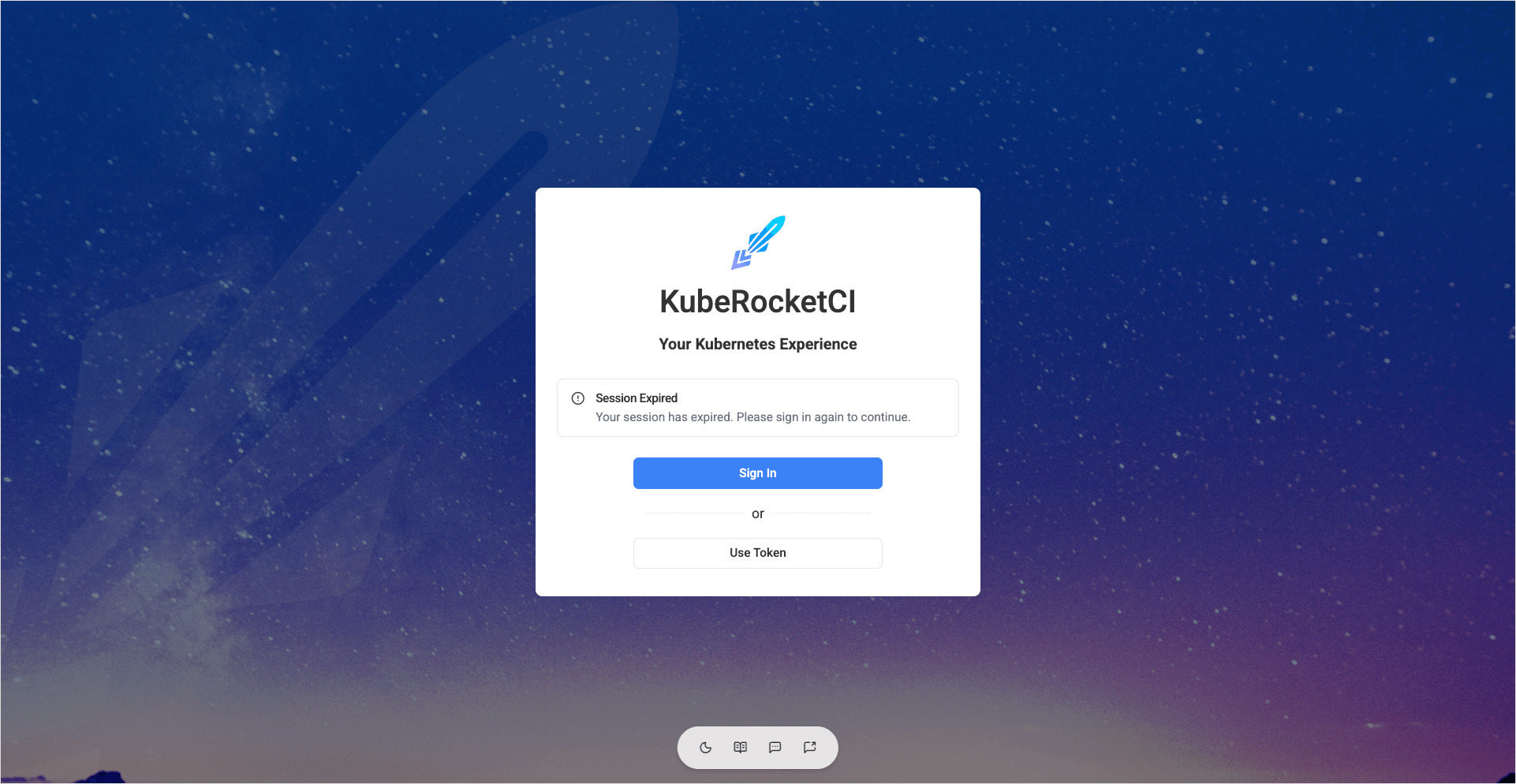
Log in to the KubeRocketCI portal:
-
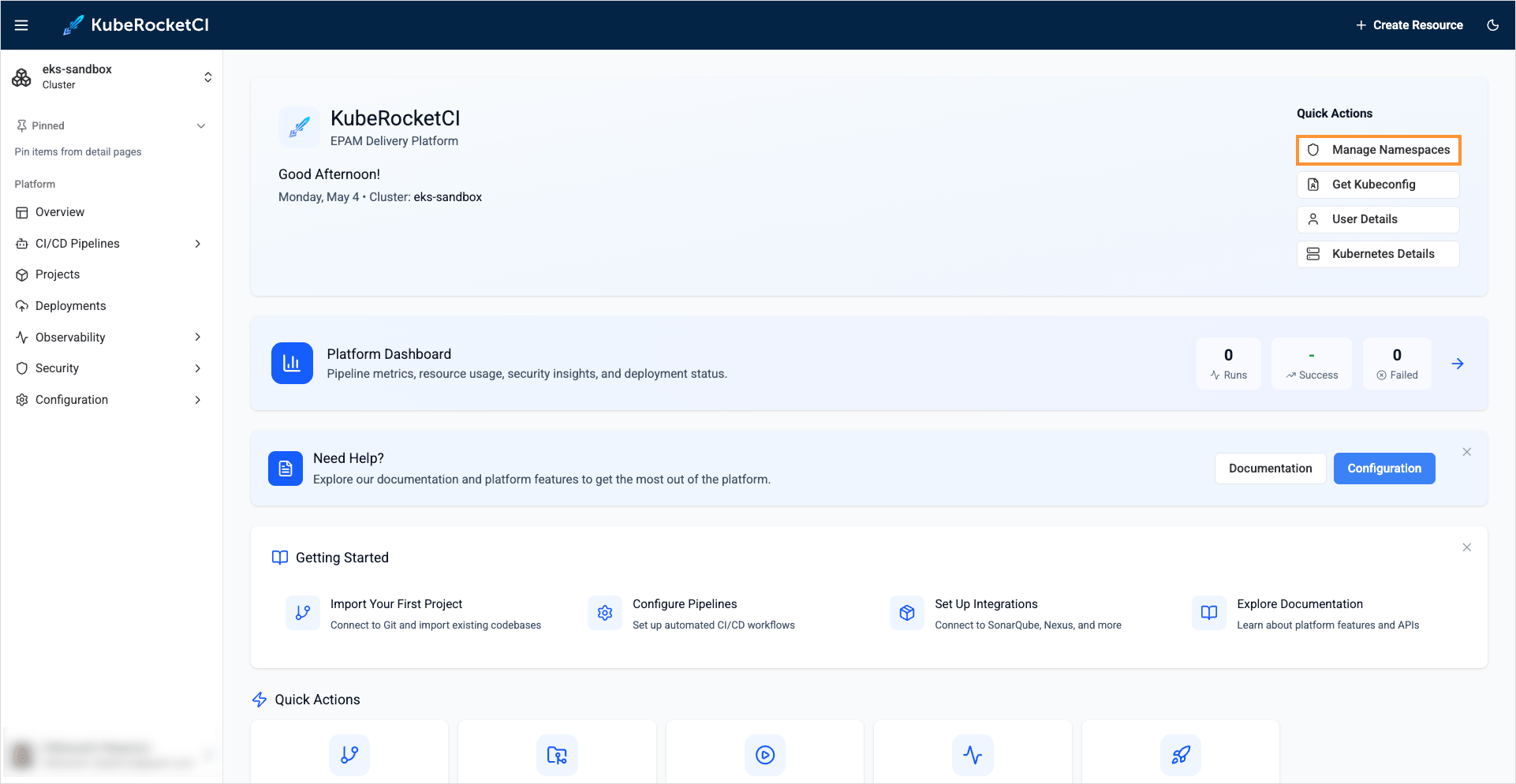
On the main menu, click the Manage Namespaces button:
-
Ensure the
Namespacevalue points to the namespace with the KubeRocketCI installation: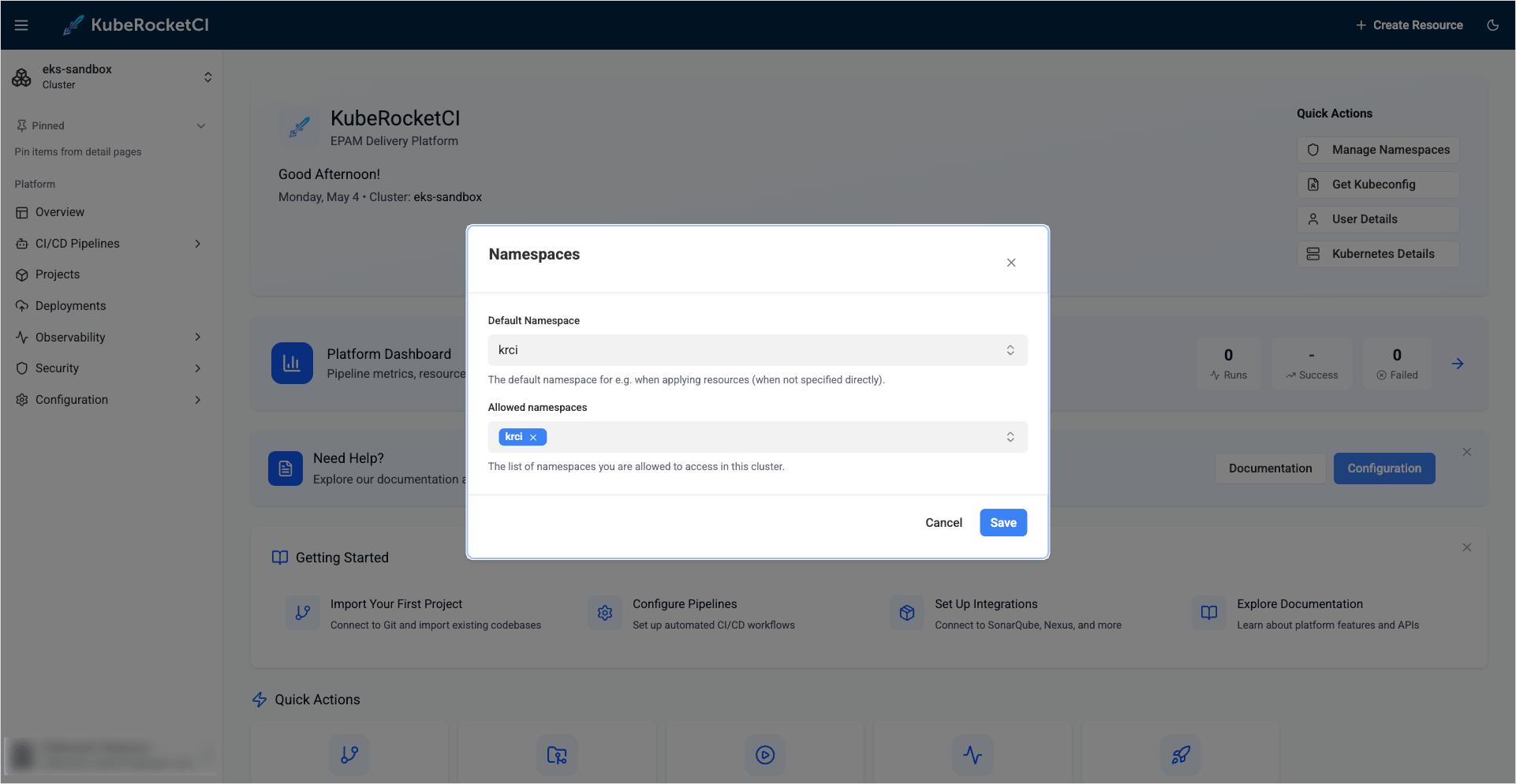 note
noteDon't forget to press Enter to add the namespace to the allowed namespaces list.
-
Create a new Project with the
Applicationtype using theCreatestrategy. Select the Projects section and click + Create project: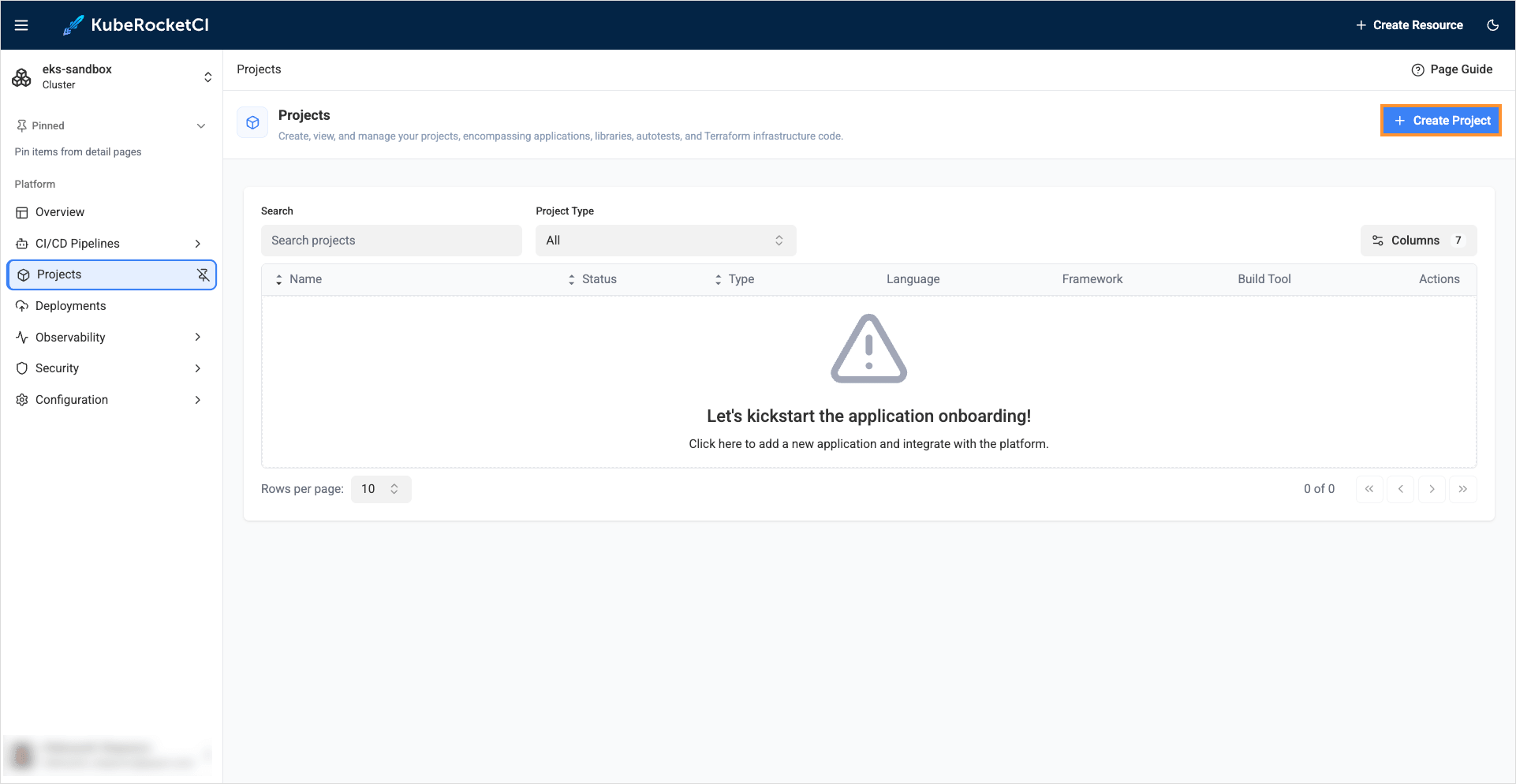
-
Select the Custom configuration option, choose the
ApplicationCodebase type as we intend to deliver our application as a container and deploy it within the Kubernetes cluster. Select the Create strategy to scaffold our application from the template provided by the KubeRocketCI and click Continue: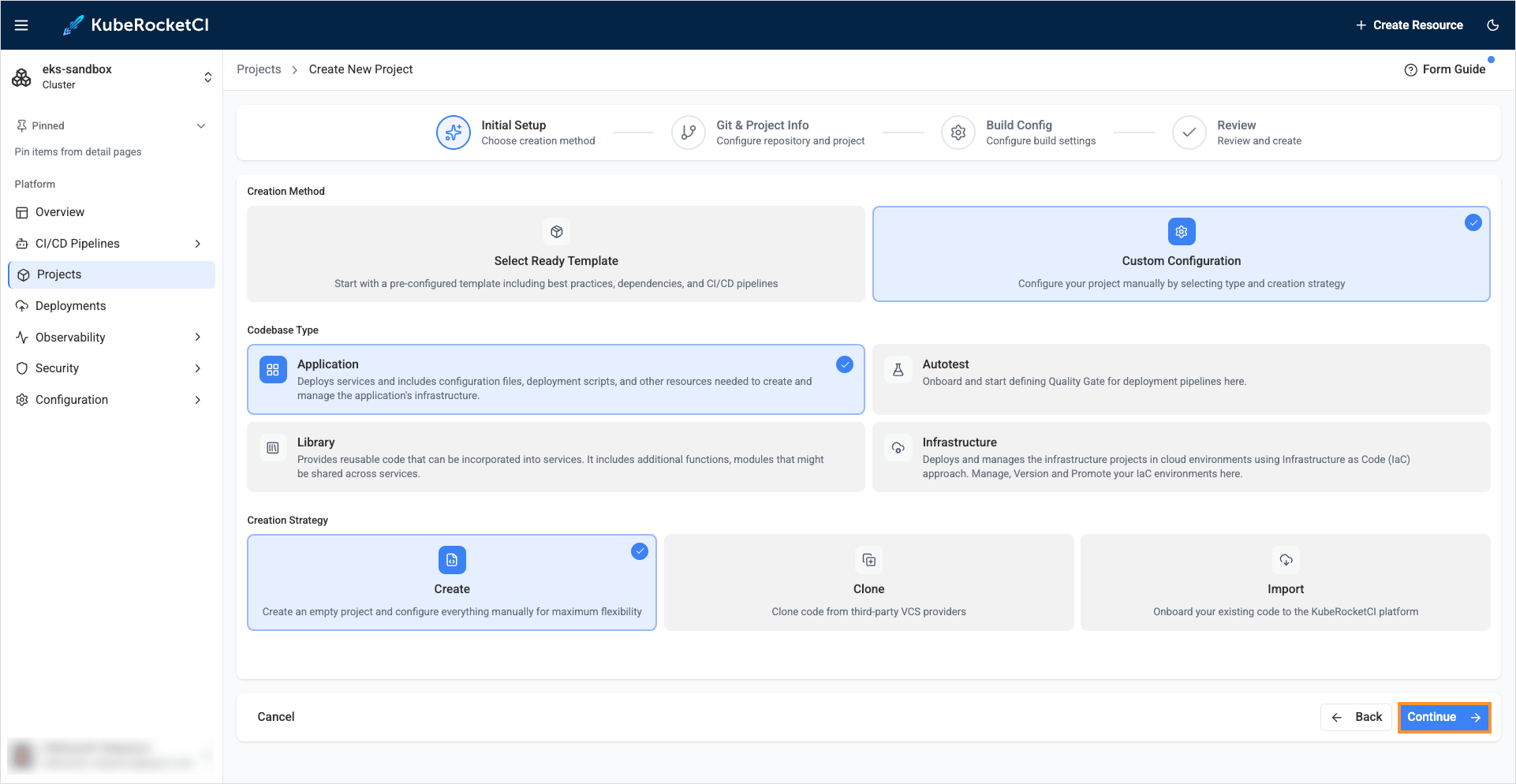
-
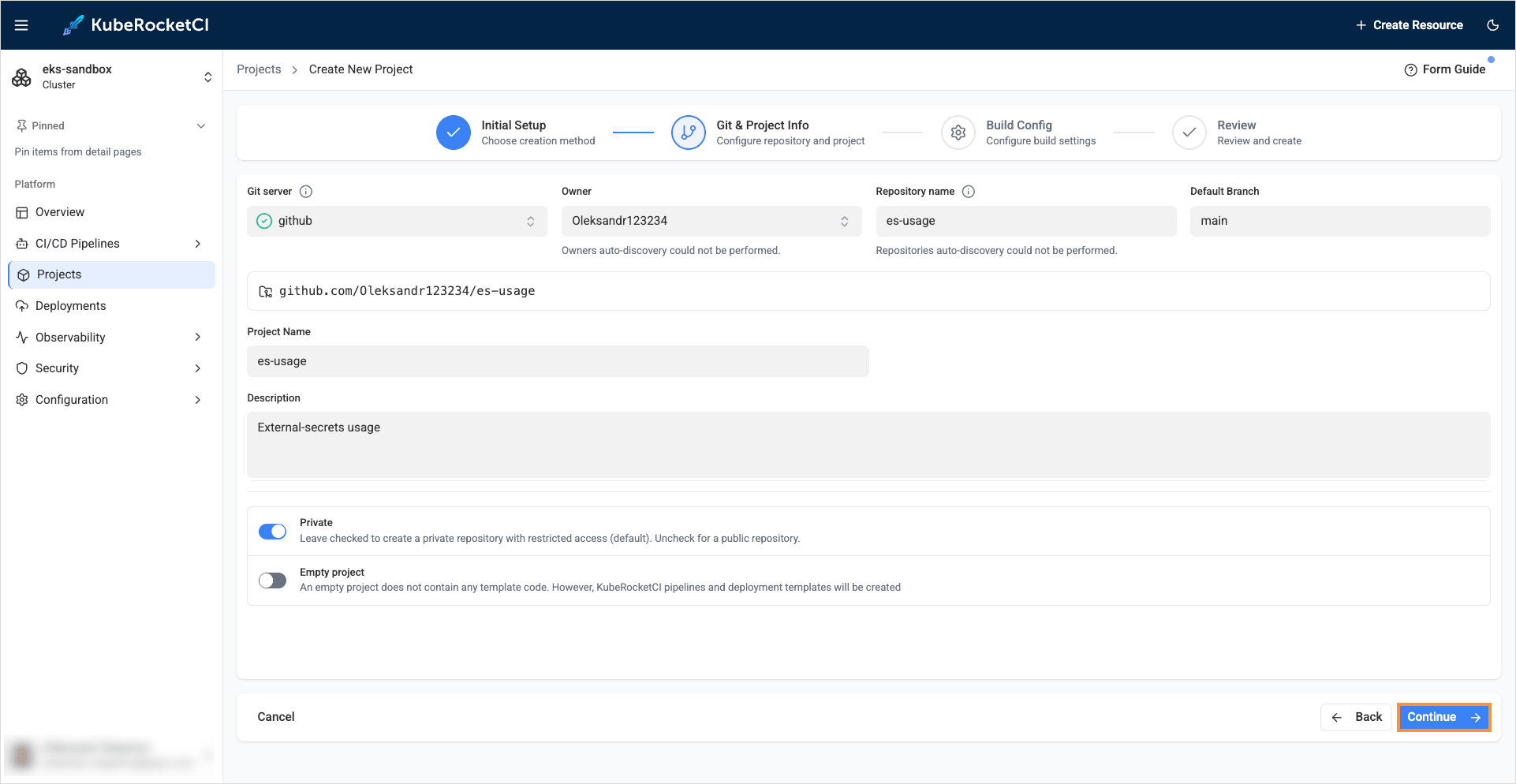
On the Git & project info tab, define the following values and click Continue:
- Git server:
github - Owner:
github_account_name - Repository name:
es-usage - Default branch:
main - Project name:
es-usage - Description:
External-secrets usage
- Git server:
-
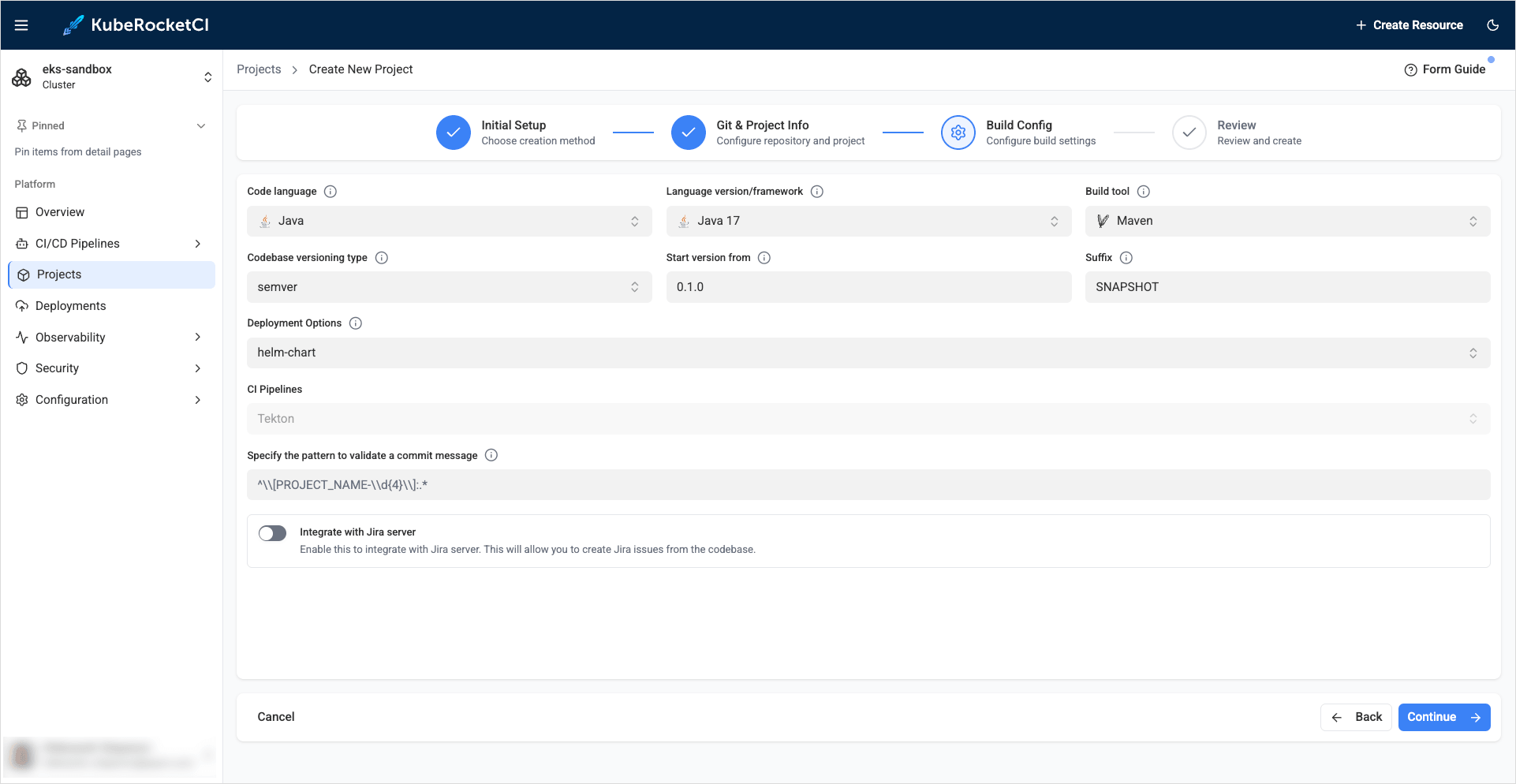
On the Build config tab, define the values and click Continue:
- Code language:
Java - Language version/framework:
Java 17 - Build tool:
Maven - Codebase versioning type:
semver - Start version from:
0.1.0 - Suffix:
SNAPSHOT - Deployment options:
helm-chart
- Code language:
-
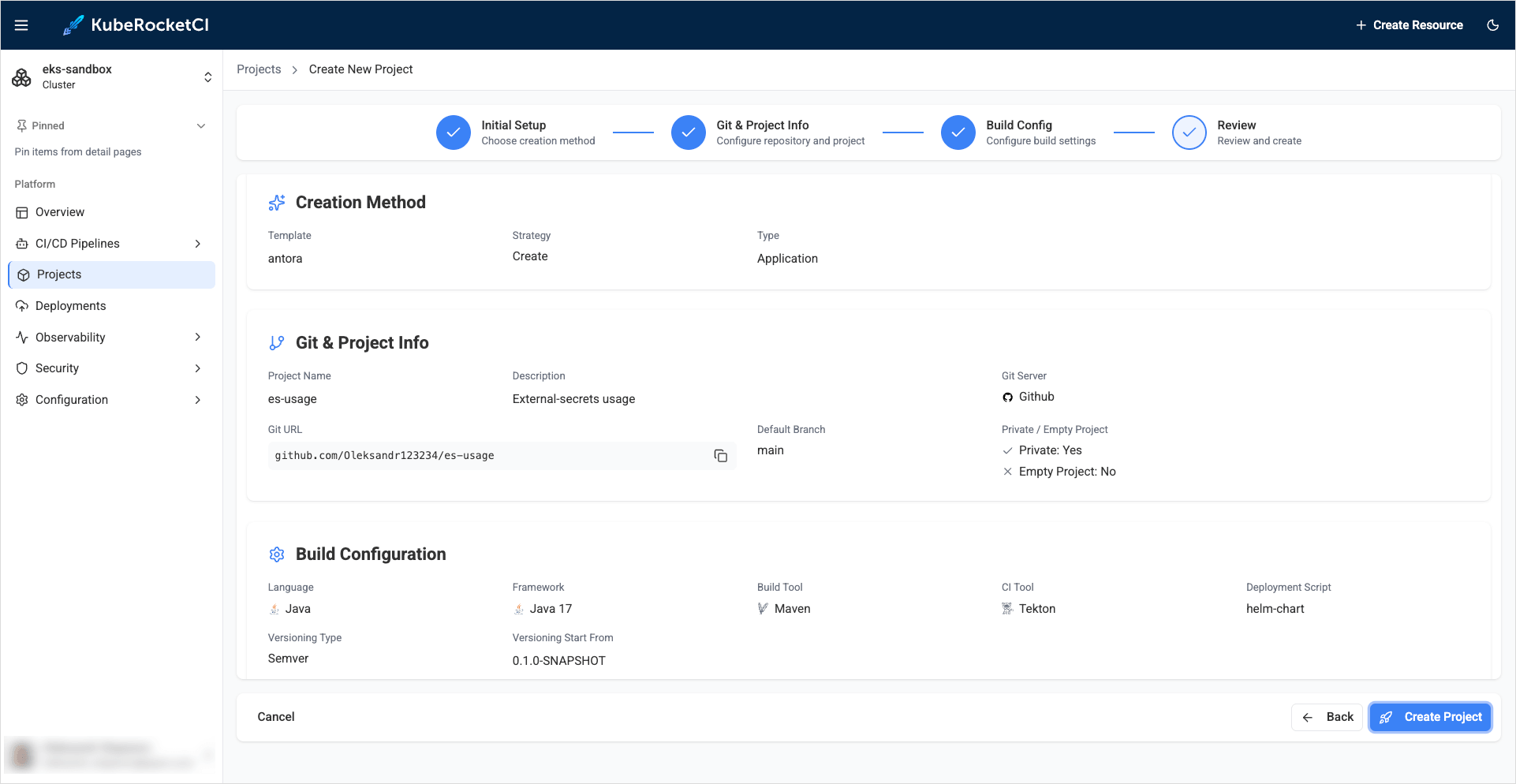
On the Review tab, verify the project configuration and click Create project:
-
Check the application status. It should be green:
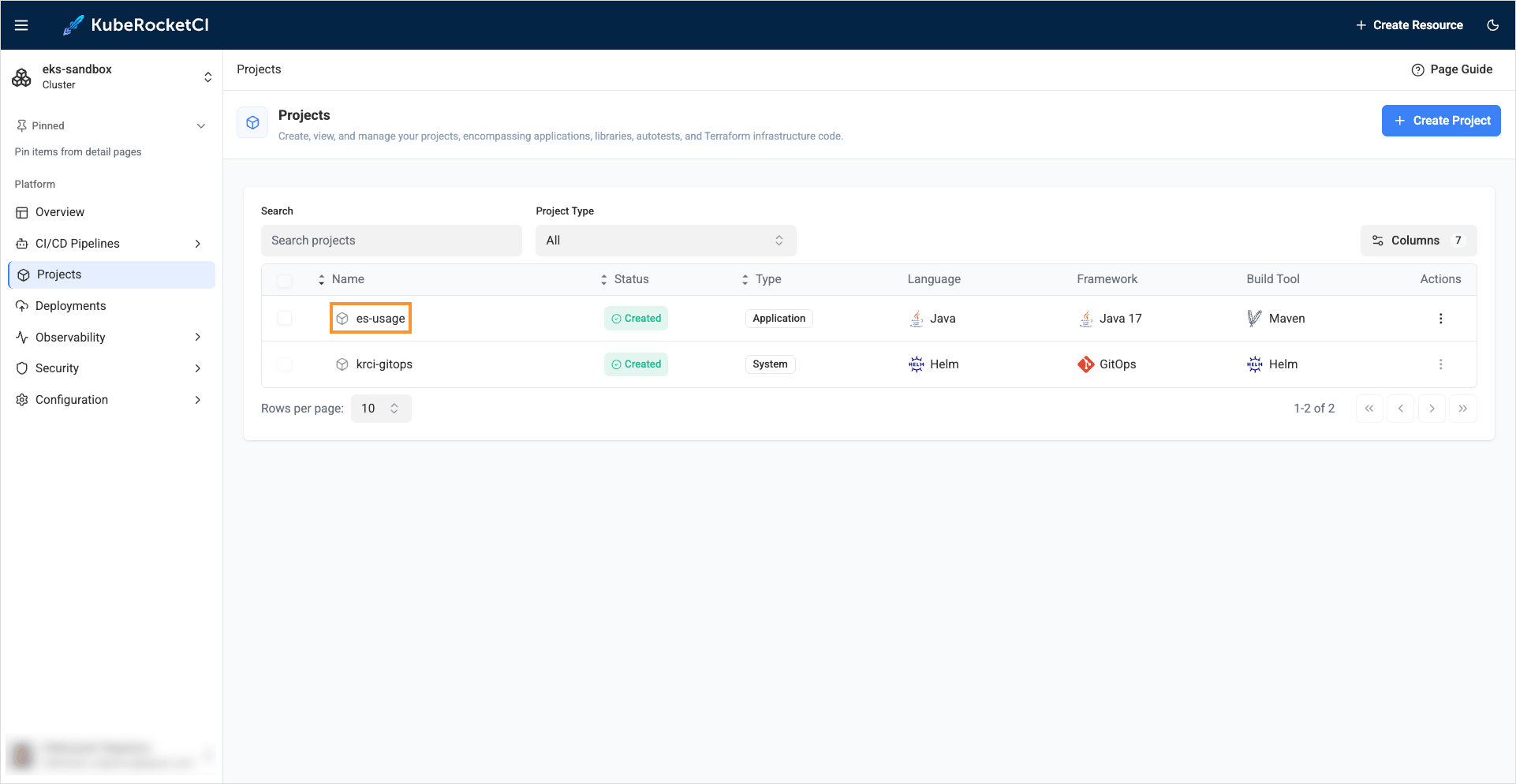
Create Deployment
This section outlines the process of establishing a CD pipeline within UI Portal. There are two fundamental steps in this procedure:
- Create a
Deployment; - Within the
Deployment, configure theEnvironment.
Ensure GitOps repository is connected to the KubeRocketCI instance.
Follow the instructions below to complete the process successfully:
-
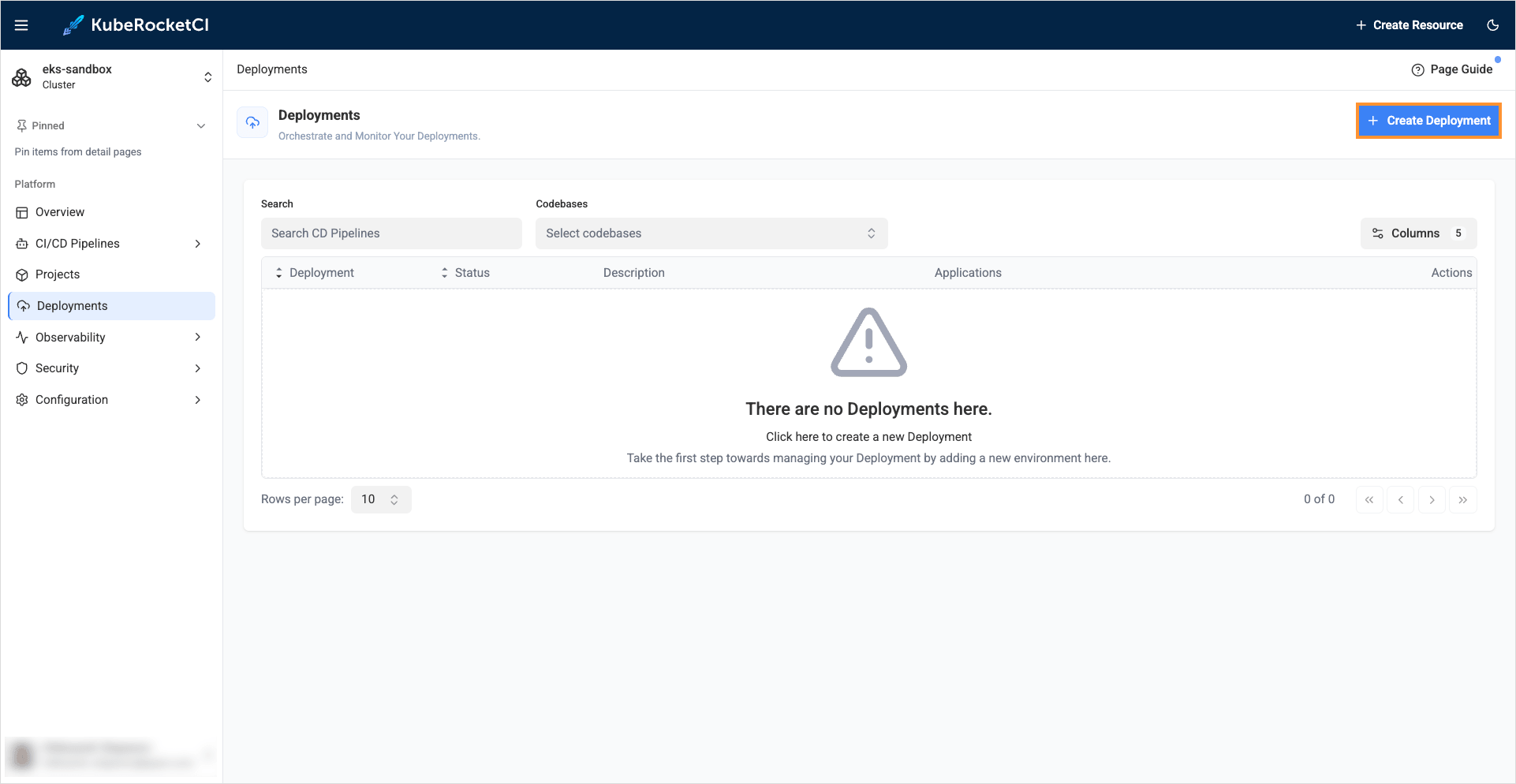
In the KubeRocketCI portal, navigate to Deployments tab and push the Create deployment button to create pipeline:
-
In the Create Deployment dialog, define the below values:
-
Applications:
-
Applications: Add
es-usageapplication -
Branch: Select the
mainbranch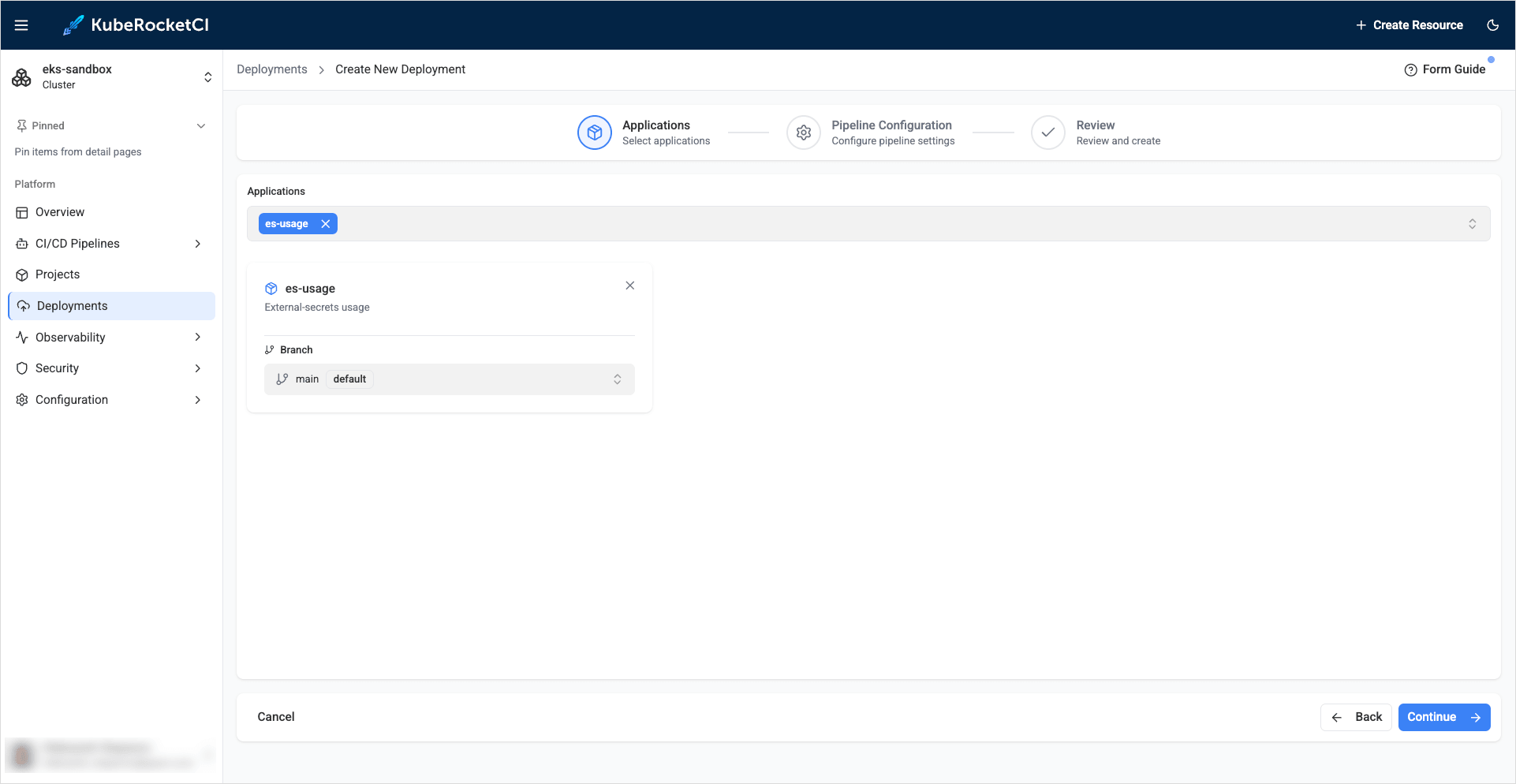
-
-
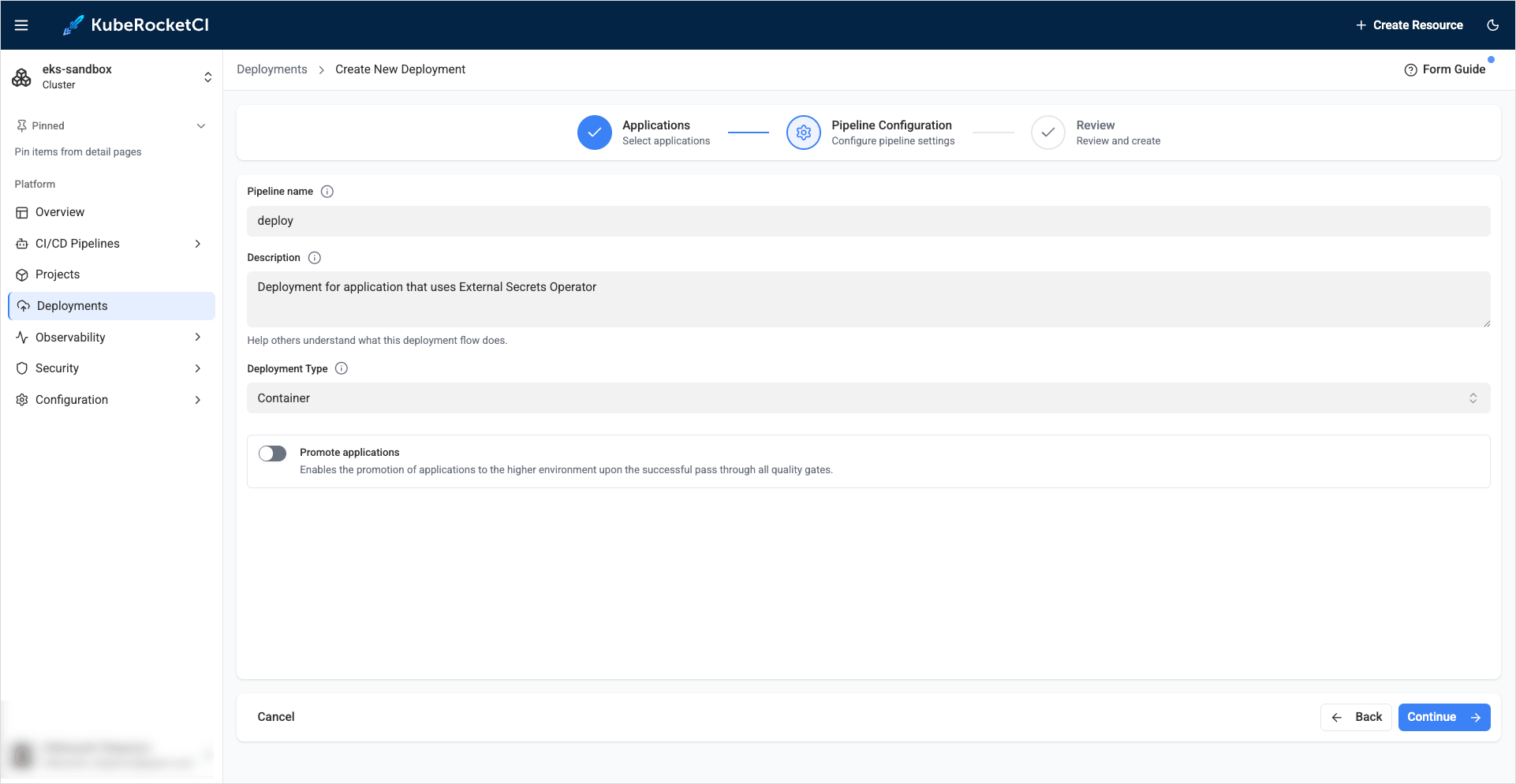
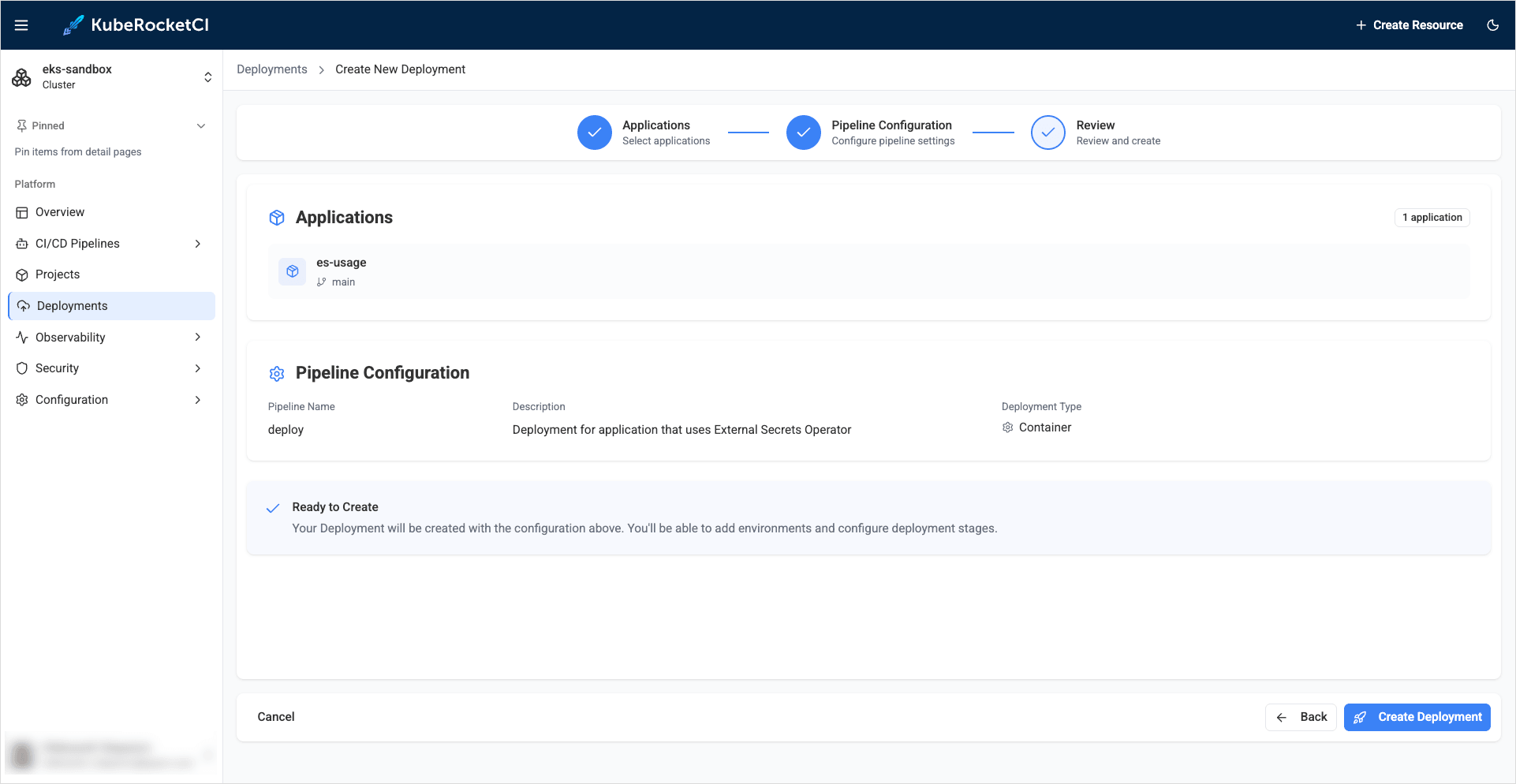
Pipeline configuration:
- Pipeline name:
deploy - Description:
Deployment for application that uses External Secrets Operator - Deployment type: Select
Container - Promote applications: Leave unchecked
- Pipeline name:
-
Review:
Verify the Deployment configuration and click Create deployment:
-
-
Click the
Open deploymentbutton to continue creating the environment: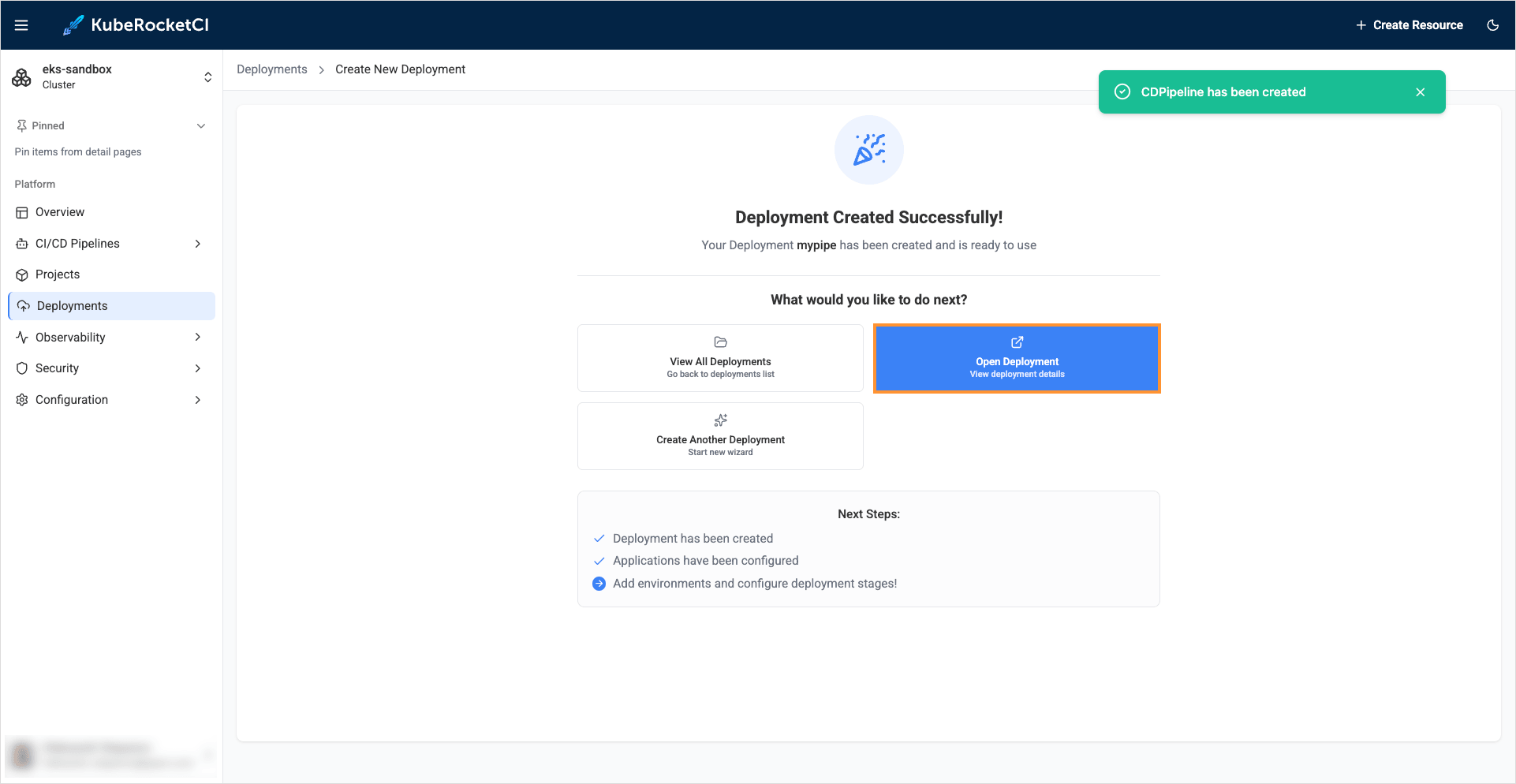
-
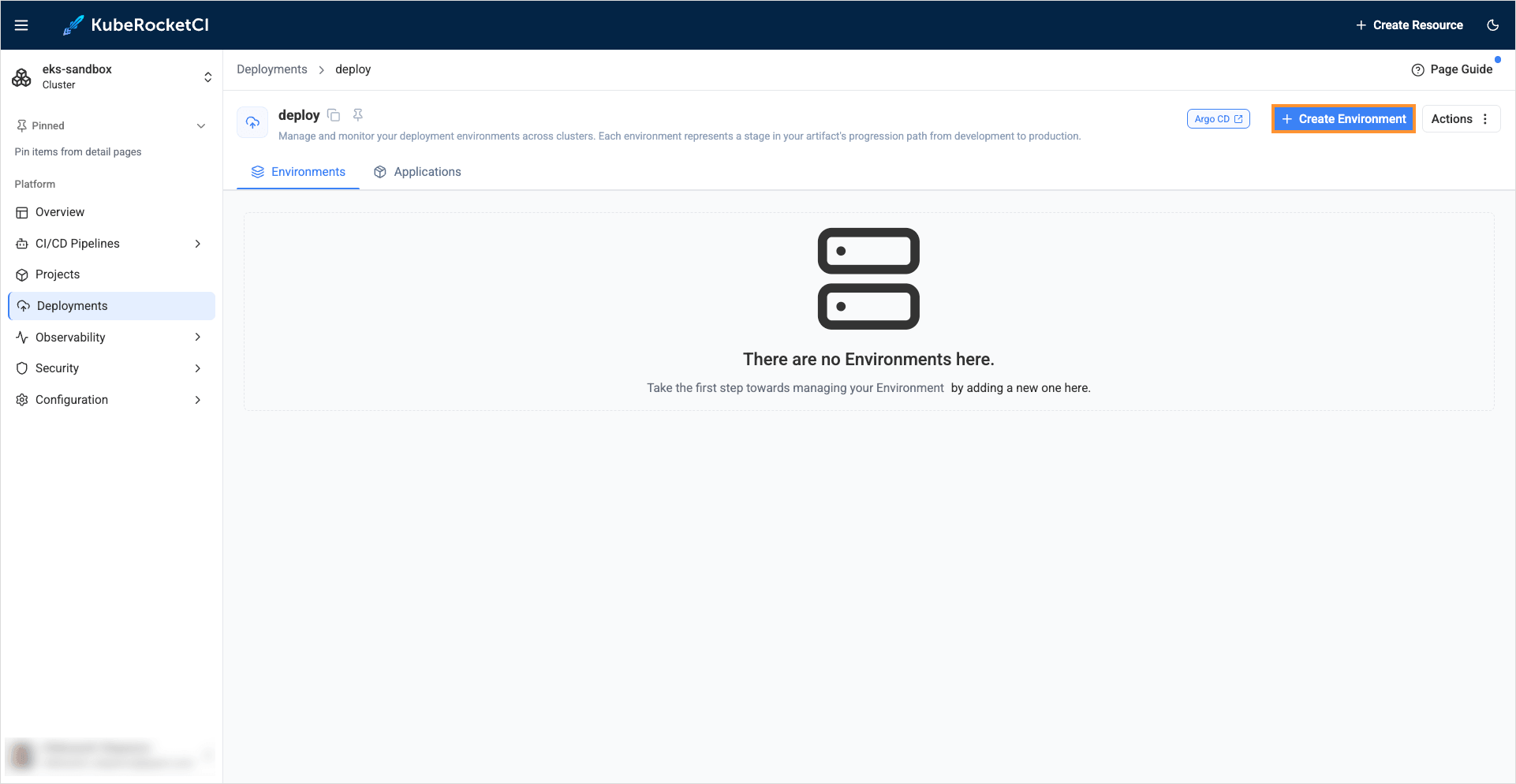
Click the + Create environment button:
-
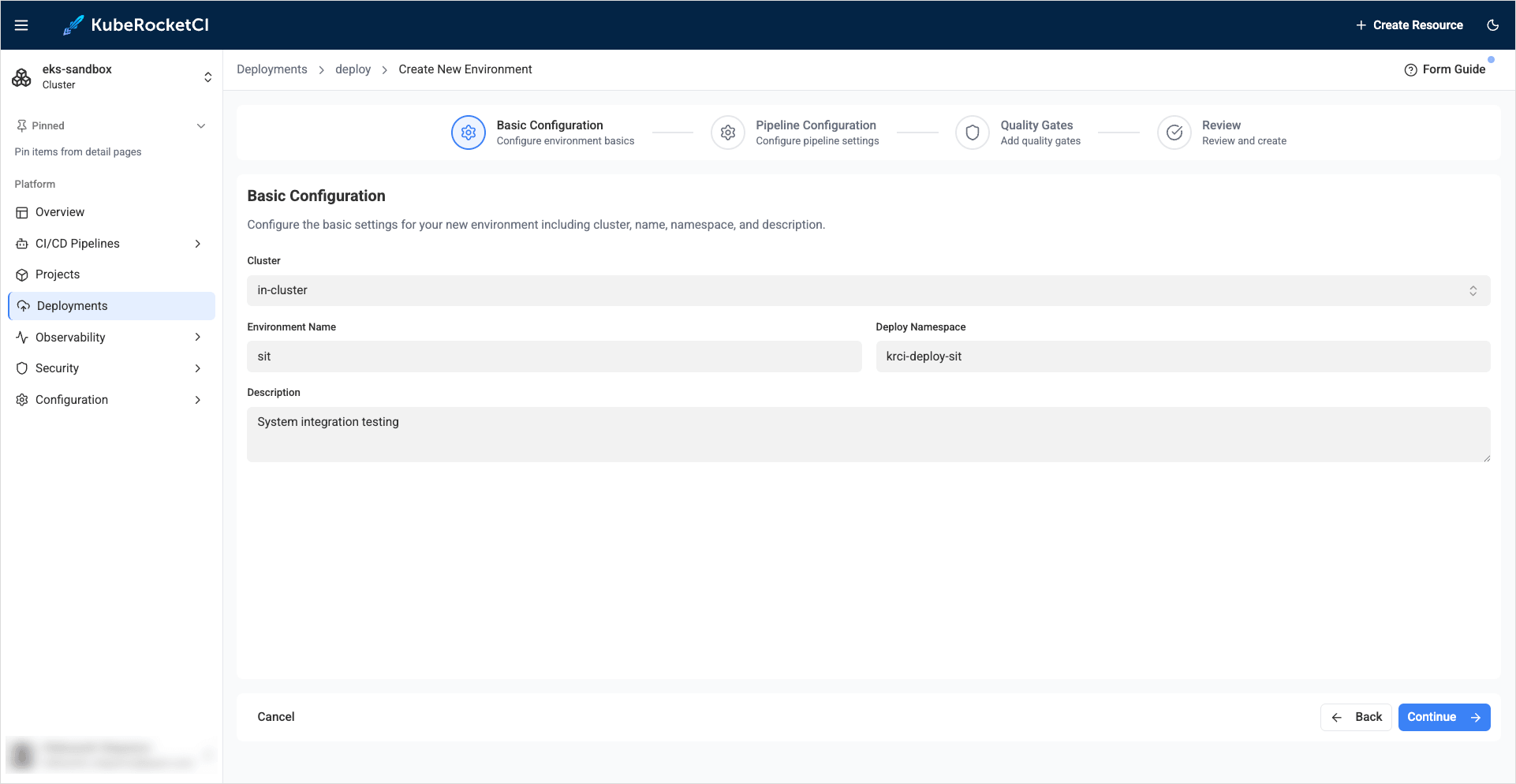
In the Create new environment dialog add the sit environment with the values below:
-
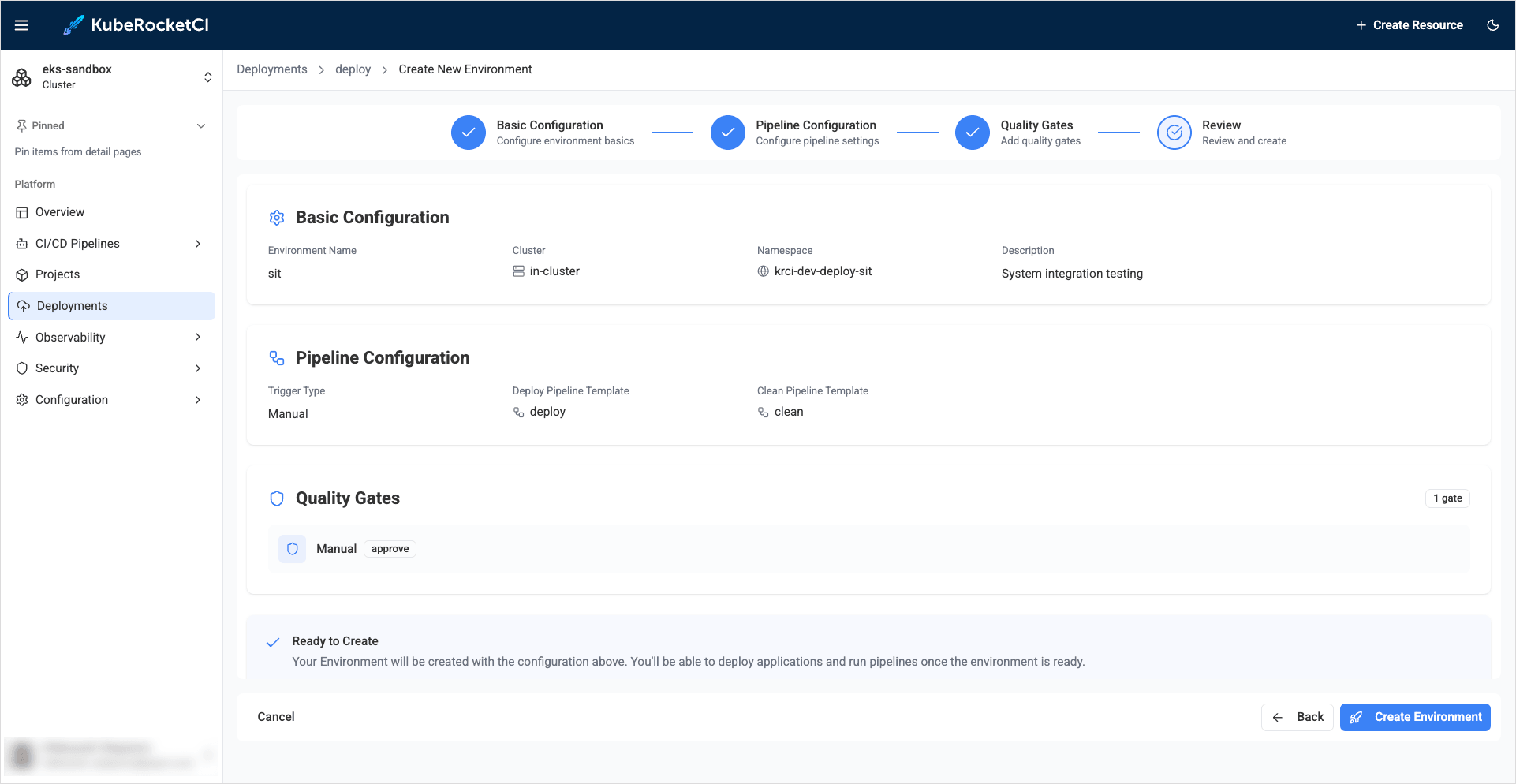
Basic configuration:
- Cluster:
in-cluster - Environment name:
sit - Deploy namespace:
krci-deploy-sit - Description:
System integration testing
- Cluster:
-
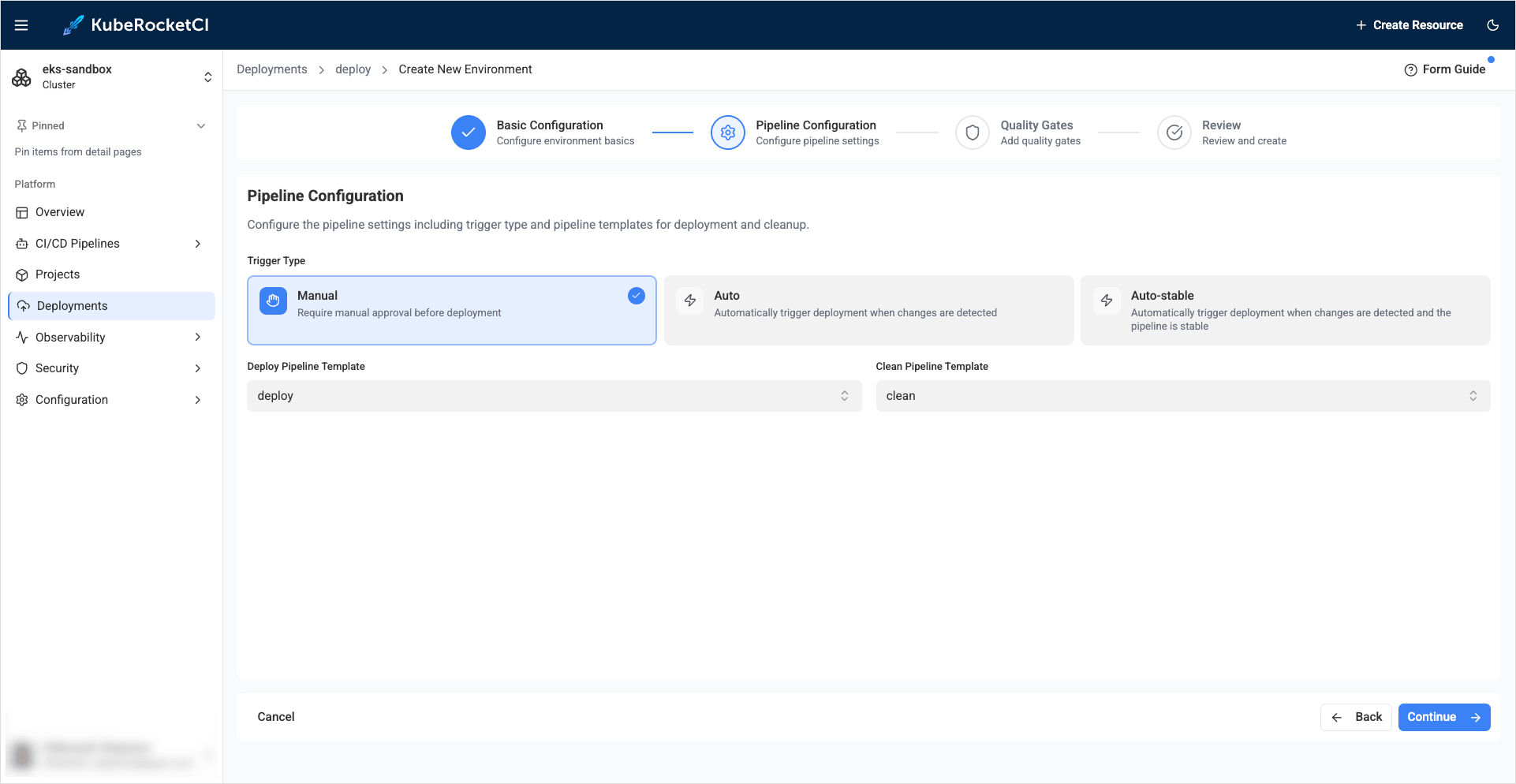
Pipeline configuration:
- Trigger type:
Manual - Deploy Pipeline template:
deploy - Clean Pipeline template:
clean
- Trigger type:
-
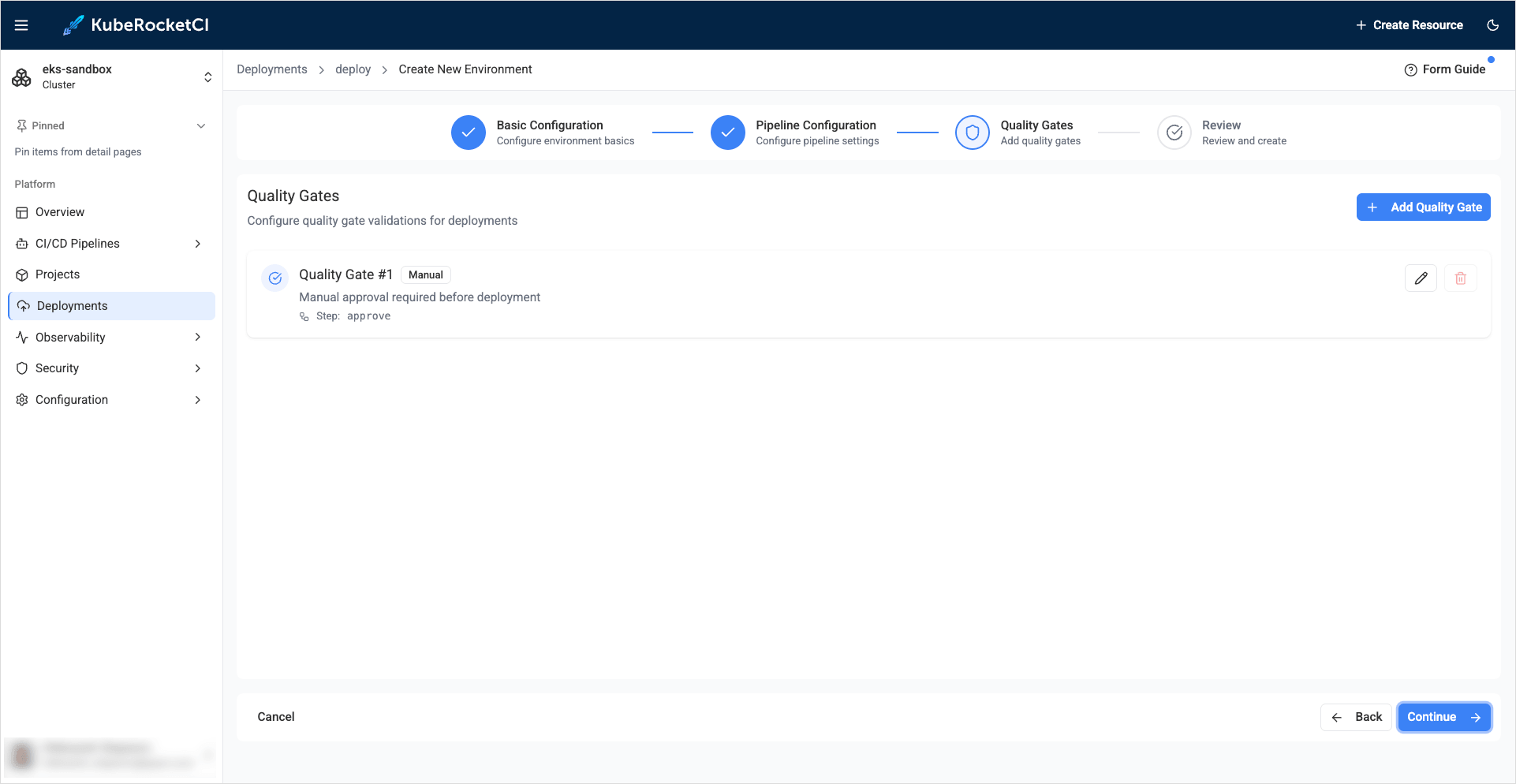
Quality Gates:
Leave everything as is:
-
Review:
Review the specified values and click the Create environment button:
-
-
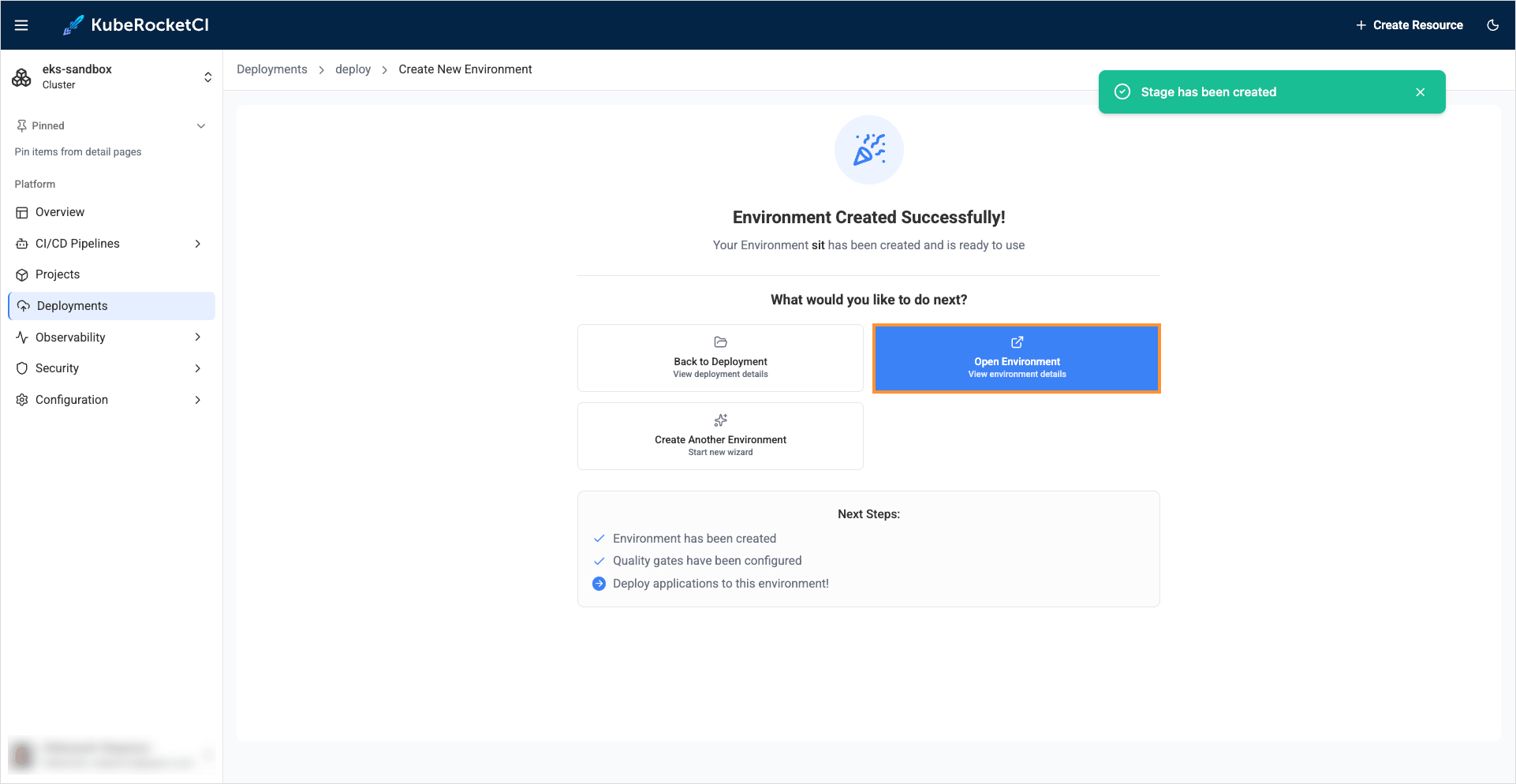
As soon as the Environment is created, click Open environment:
Configure RBAC for External Secret Store
Three namespaces are used:
krci, the namespace where KubeRocketCI is deployed;krci-vault, the vault namespace where sensitive data is stored;krci-deploy-sit, the Deploy namespace for the application (same value as in Create environment → Basic configuration → Deploy namespace).
The application deploy namespace is not arbitrary: the UI suggests a name derived from the KubeRocketCI installation namespace, environment name, and stage name (see Create Environment). In this guide the platform namespace is krci, the Deployment is named deploy, the Environment name is sit, and the deploy target is krci-deploy-sit — use the same string everywhere below (RoleBinding subject namespace, Helm templates, kubectl -n, and allowed namespaces in the portal).
To ensure the proper functioning of the system, it is crucial to create the following resources:
-
Create namespace
krci-vaultto store secrets:kubectl create namespace krci-vault -
Create Secret:
apiVersion: v1kind: Secretmetadata:name: mongonamespace: krci-vaultstringData:password: passusername: usertype: Opaque -
Create Role to access the Secret:
apiVersion: rbac.authorization.k8s.io/v1kind: Rolemetadata:namespace: krci-vaultname: external-secret-storerules:- apiGroups: [""]resources:- secretsverbs:- get- list- watch- apiGroups:- authorization.k8s.ioresources:- selfsubjectrulesreviewsverbs:- create -
Create RoleBinding:
apiVersion: rbac.authorization.k8s.io/v1kind: RoleBindingmetadata:name: eso-from-krcinamespace: krci-vaultsubjects:- kind: ServiceAccountname: secret-managernamespace: krci-deploy-sitroleRef:apiGroup: rbac.authorization.k8s.iokind: Rolename: external-secret-store
Add External Secret to Helm Chart
Now that RBAC is configured properly, it is time to add external secrets templates to application Helm chart. Follow the instructions provided below:
-
Navigate to one of the
Git Serverswhere thees-usageapplication was created during the Add Application step. In this example, it isGitHub: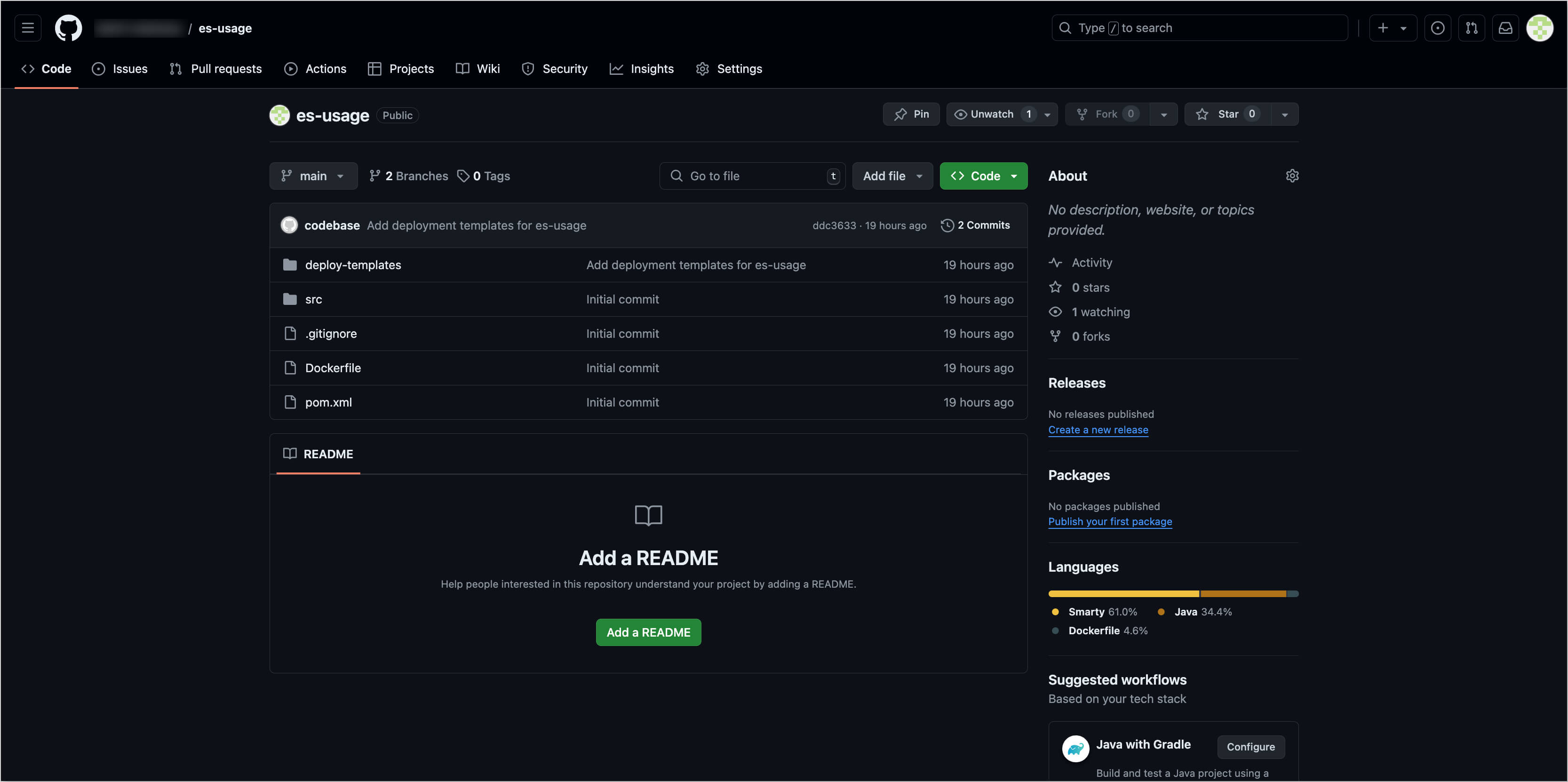
-
Create a commit in the
es-usagerepository and add the following configuration files to the Helm chart:-
deploy-templates/templates/sa.yaml:apiVersion: v1kind: ServiceAccountmetadata:name: secret-managernamespace: krci-deploy-sit -
deploy-templates/templates/secret-store.yaml:apiVersion: external-secrets.io/v1kind: SecretStoremetadata:name: krci-vault-storenamespace: krci-deploy-sitspec:provider:kubernetes:remoteNamespace: krci-vaultauth:serviceAccount:name: secret-managerserver:caProvider:type: ConfigMapname: kube-root-ca.crtkey: ca.crt -
deploy-templates/templates/external-secret.yaml:apiVersion: external-secrets.io/v1kind: ExternalSecretmetadata:name: mongo # target secret namenamespace: krci-deploy-sit # target namespacespec:refreshInterval: 1hsecretStoreRef:kind: SecretStorename: krci-vault-storedata:- secretKey: username # target value propertyremoteRef:key: mongo # remote secret keyproperty: username # value will be fetched from this field- secretKey: password # target value propertyremoteRef:key: mongo # remote secret keyproperty: password # value will be fetched from this field -
deploy-templates/templates/deployment.yaml. Add the environment variable for mongodb to the existing deployment configuration that used the secret:env:- name: MONGO_USERNAMEvalueFrom:secretKeyRef:name: mongokey: username- name: MONGO_PASSWORDvalueFrom:secretKeyRef:name: mongokey: password
-
-
Push the changes made to the
es-usagerepository.
Deploy Application
Deploy the application by following the steps below:
-
Build Container from the latest branch commit. To build the initial version of the application's
mainbranch, go to the Projects -> es-usage -> Branches -> main and press the Trigger build pipeline run button: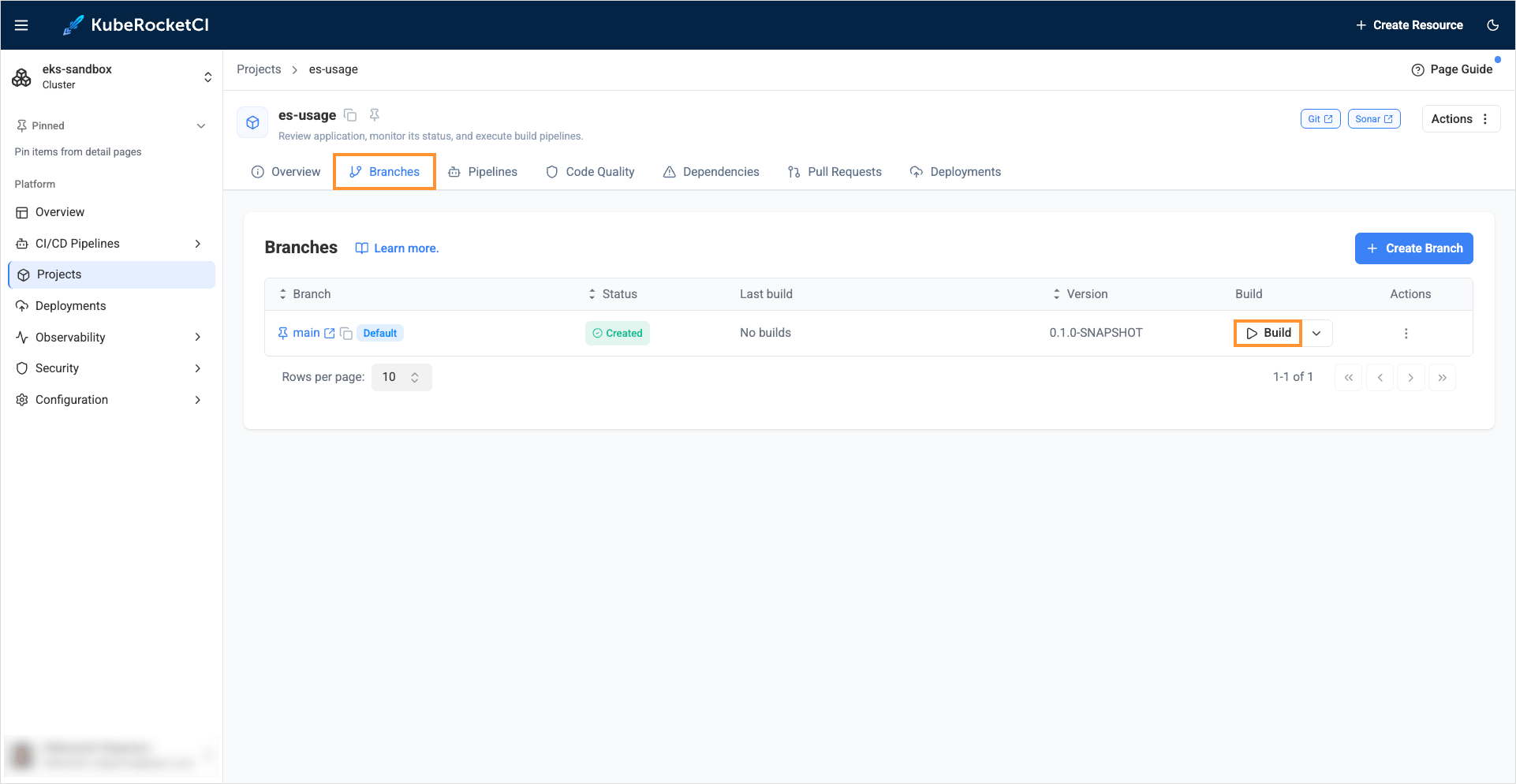
-
Build pipeline for the
es-usageapplication starts: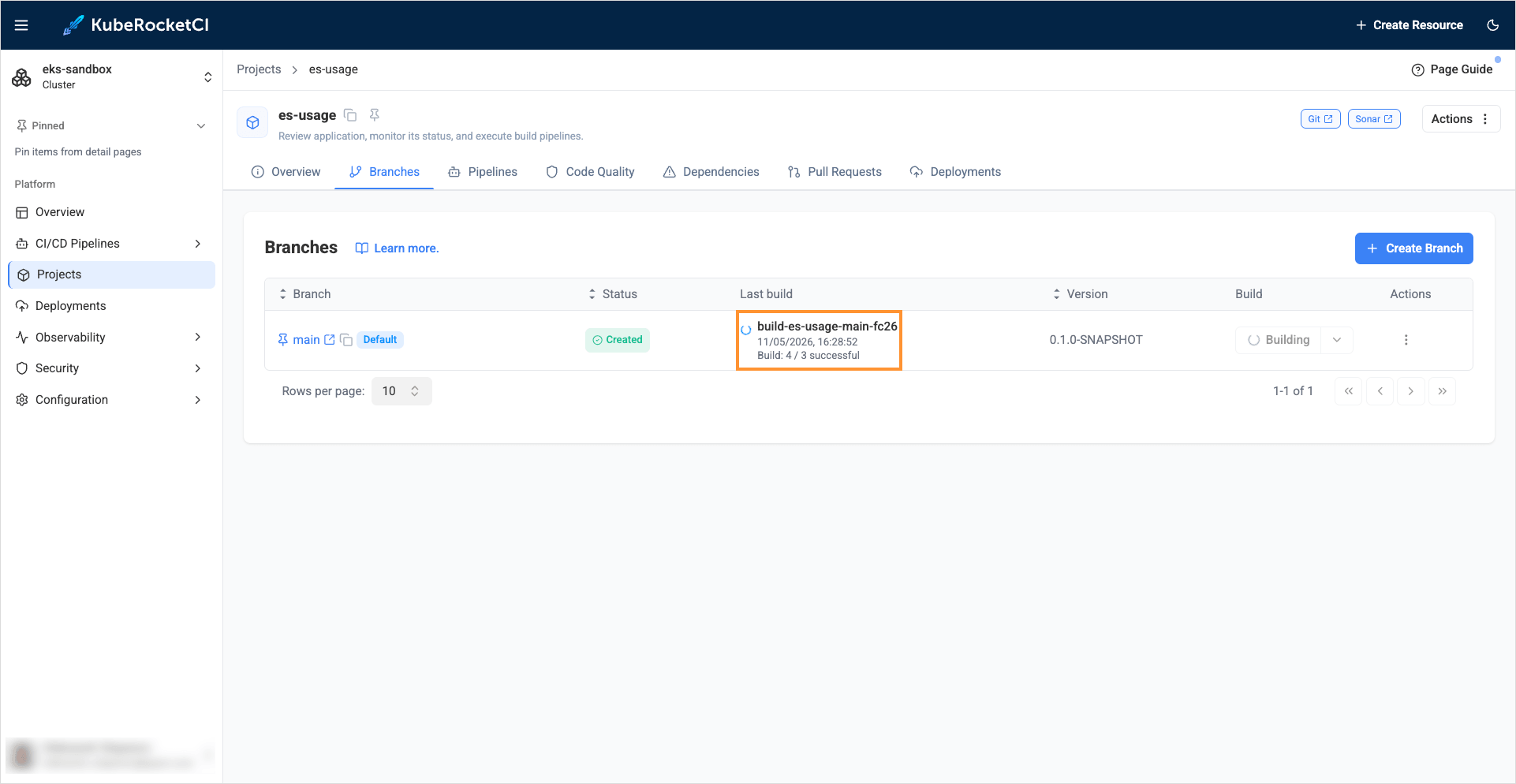
-
Once the build pipeline has successfully completed, navigate to the Deployments tab and select the
deploypipeline: Choose the sit environment and click on the Configure deploy button: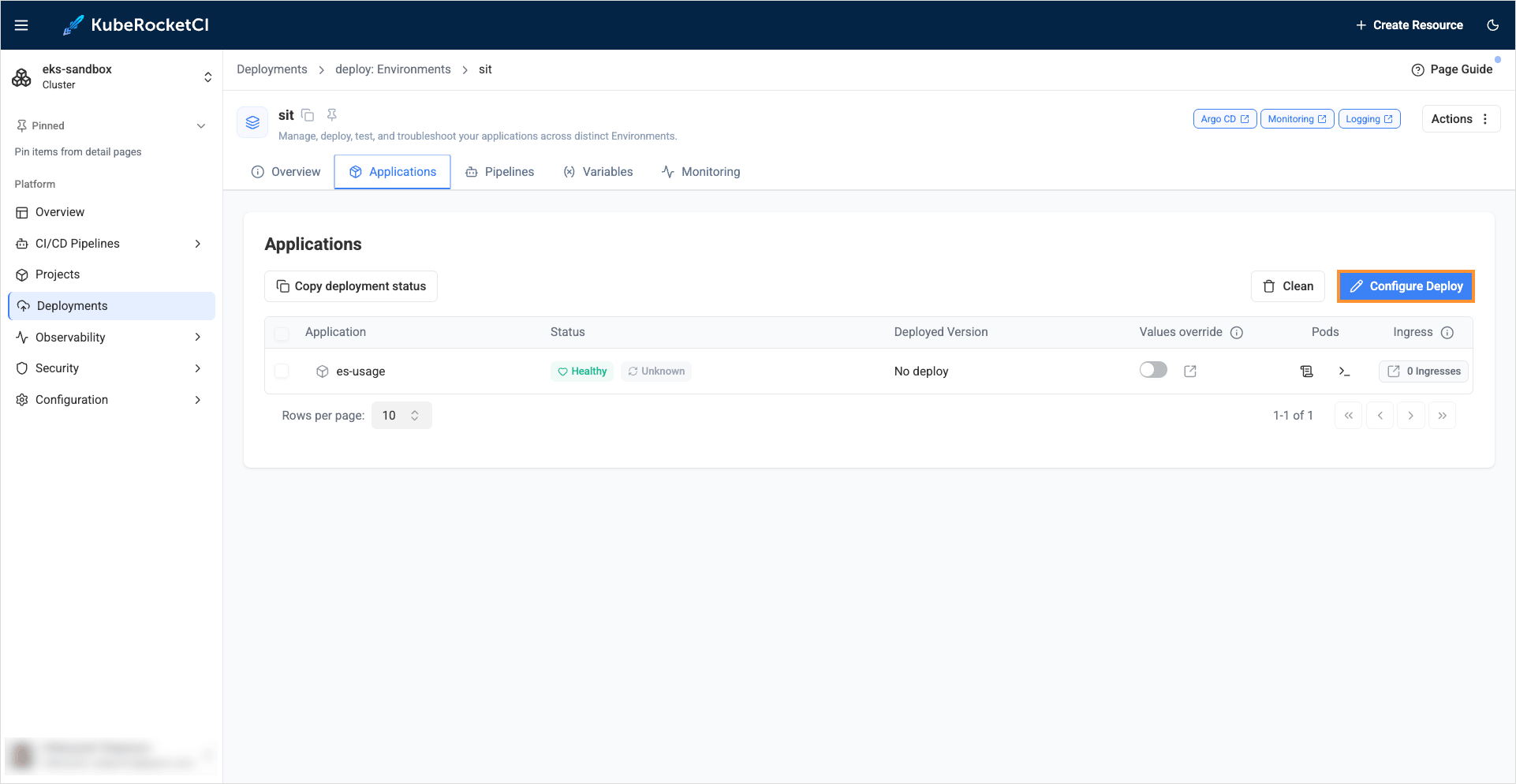
-
In the
Image stream version, select latest version and push the Start deploy button: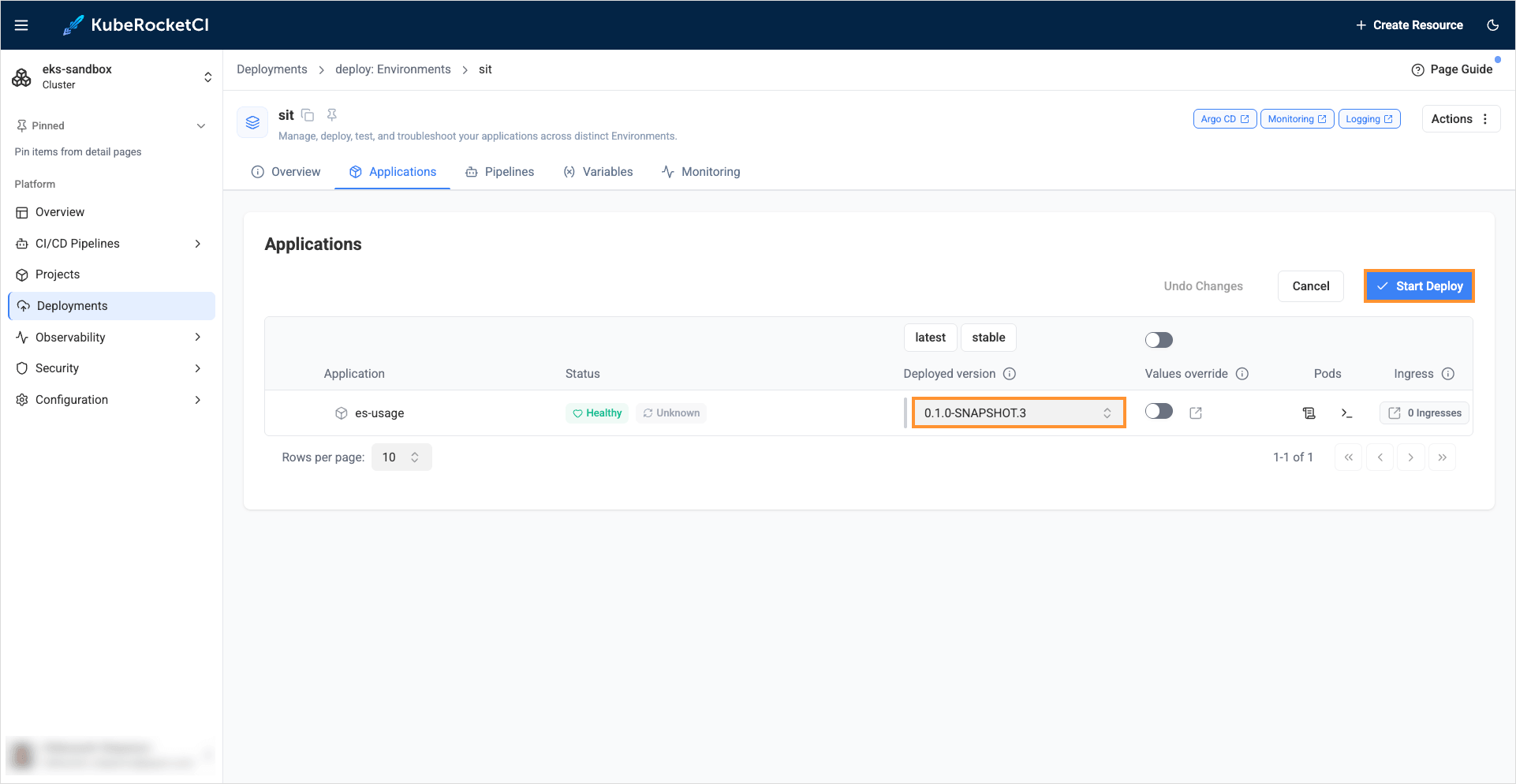
-
Ensure application status is
HealthyandSynced: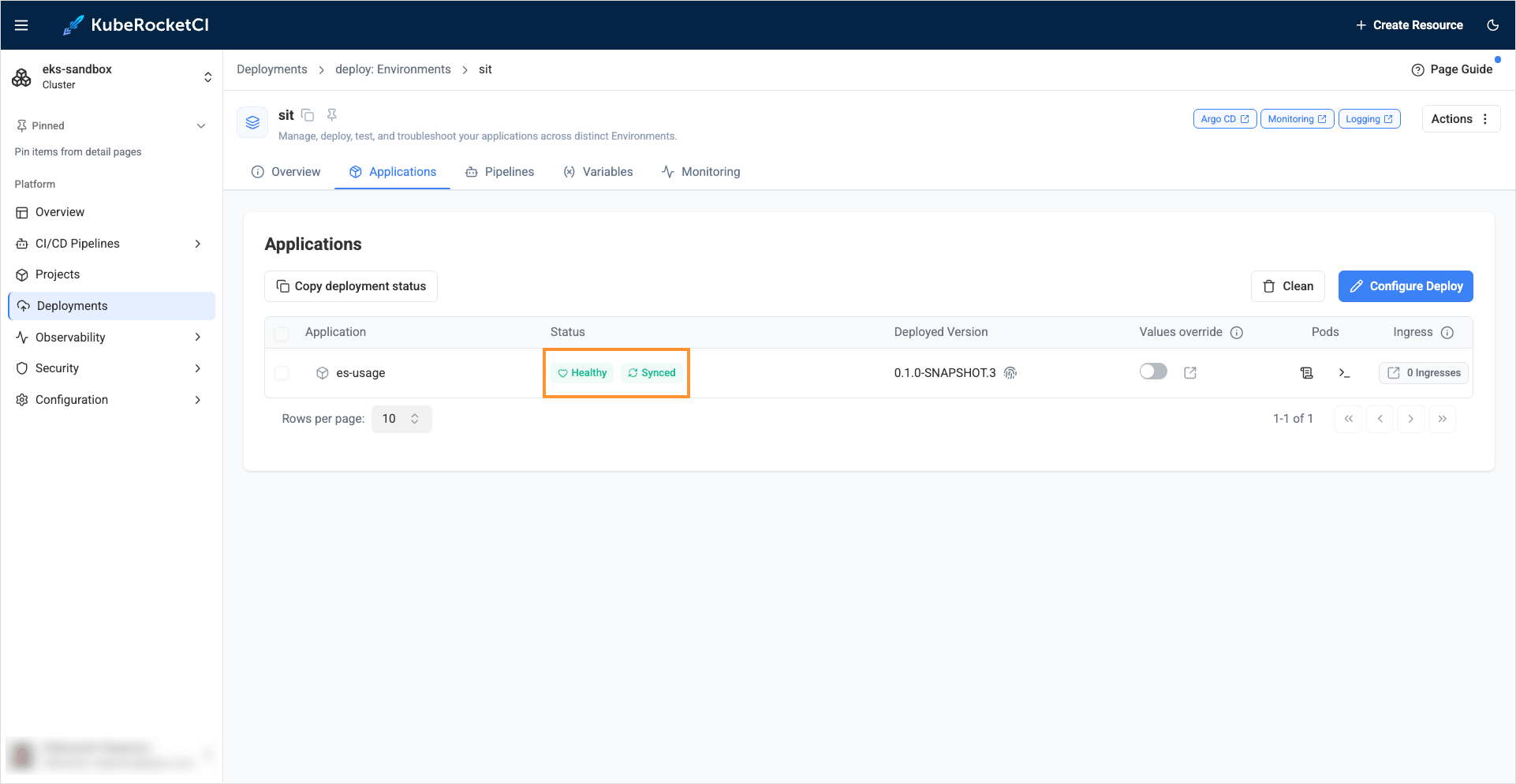
Check Application Status
To ensure the application is deployed successfully, use kubectl with a context that can read the deploy namespace (replace krci-deploy-sit if your Deploy namespace differs).
-
Check that External Secrets resources are reconciled:
kubectl get secretstore -n krci-deploy-sitNAME AGE STATUS CAPABILITIES READYkrci-vault-store 4m38s Valid ReadWrite Truekubectl get externalsecret -n krci-deploy-sitNAME STORE REFRESH INTERVAL STATUS READYmongo krci-vault-store 1h SecretSynced TrueIf
READYis notTrue, inspect events:kubectl describe externalsecret mongo -n krci-deploy-sitkubectl describe secretstore krci-vault-store -n krci-deploy-sit -
Confirm the Kubernetes
Secretnamedmongoexists in the deploy namespace (created by ESO from the vault):kubectl get secret mongo -n krci-deploy-sitConfirm keys exist (values stay hidden in this output):
kubectl describe secret mongo -n krci-deploy-sitUnder Data, expect keys
usernameandpassword.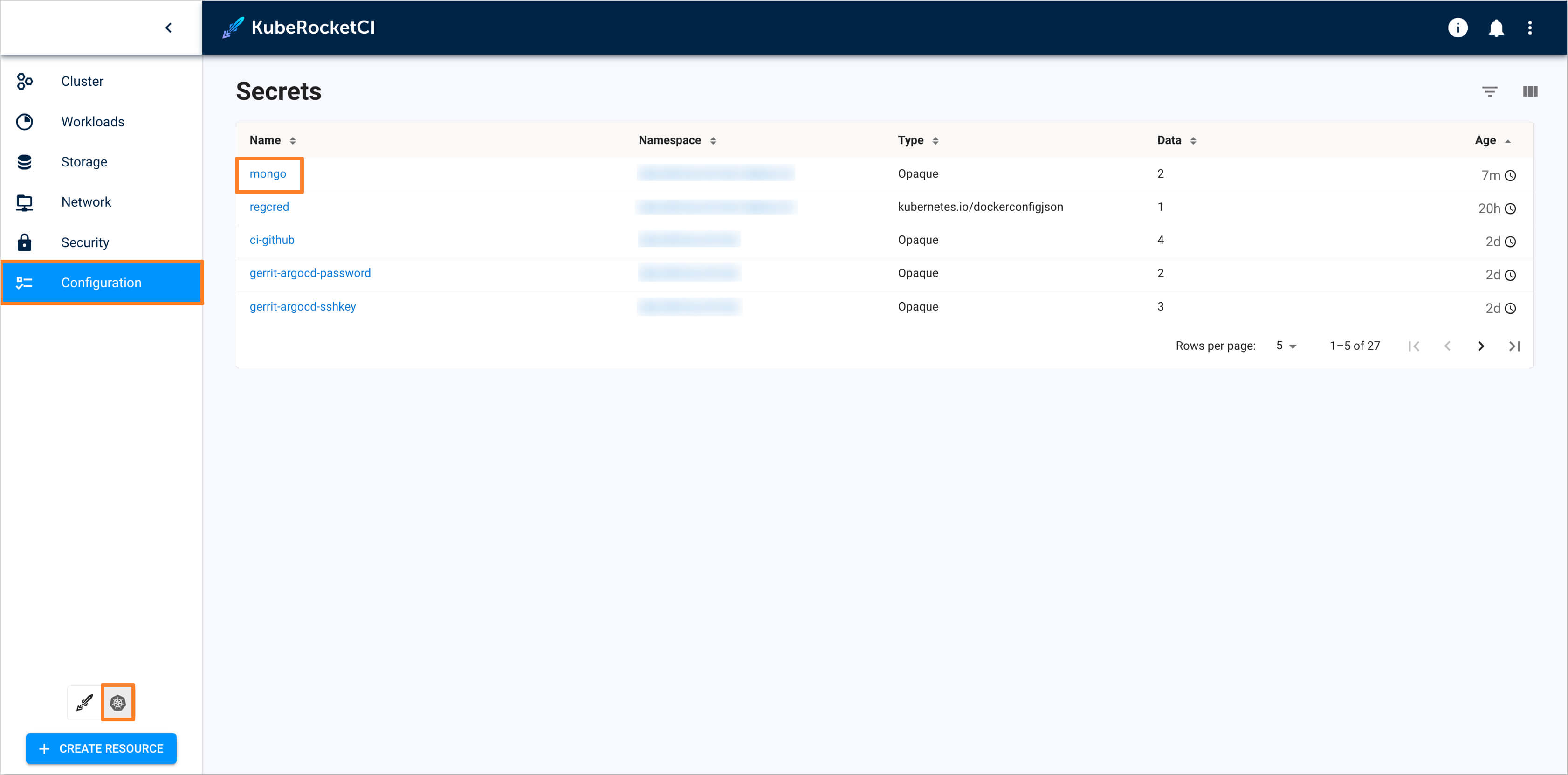
-
See which Secrets the workload is wired to (desired state from the
Deployment; values are never printed here):kubectl get deploymentonly shows high-level fields (replicas, image, etc.), not secret references. Usedescribeorget -o yamlon theDeploymentto inspect the Pod template.kubectl get deployment -n krci-deploy-sit -l app.kubernetes.io/name=es-usagekubectl describe deployment -n krci-deploy-sit -l app.kubernetes.io/name=es-usageEnvironment:MONGO_USERNAME: <set to the key 'username' in secret 'mongo'> Optional: falseMONGO_PASSWORD: <set to the key 'password' in secret 'mongo'> Optional: falseThat output means the Deployment injects those keys from the
mongoSecret into every Pod it creates.Optional — compact list of env vars that use
secretKeyRef(requires a single Deployment in the selector result):kubectl get deployment -n krci-deploy-sit -l app.kubernetes.io/name=es-usage \-o jsonpath='{range .items[0].spec.template.spec.containers[0].env[*]}{.name}{"\t"}{.valueFrom.secretKeyRef.name}{"\t"}{.valueFrom.secretKeyRef.key}{"\n"}{end}'Each line is:
VARIABLE_NAME, Secret name, Secret key. Empty lines can appear for env entries that are not backed by a Secret (ignore them).
The steps above confirm External Secrets, the synced mongo Secret, and the desired Pod template on the Deployment. If the application misbehaves or Pods are not healthy anyway, inspect runtime state with kubectl describe pod (and Pod events) in the deploy namespace, and review the Argo CD Application resource that owns this release (sync status, rendered manifests, and events in the Argo CD UI or via kubectl get application -n <argocd-namespace> / kubectl describe application as appropriate for your installation).